Contact Us

AI Visibility Explained

What Is AI Visibility, and Why Does It Decide Who Gets the Call?

People are asking ChatGPT, Gemini, and Google AI Overviews for recommendations instead of scrolling through ten blue links. Two or three business names come back. The conversation ends.

AI visibility is whether your name is one of them. This page explains what it means, how AI systems decide, and why it's becoming a core layer of how customers find businesses.

Plain-English explainer  ·  Built on current 2026 data  ·  Free audit available  ·  Canadian-operated

The Definition

AI Visibility Is a New Layer of Search — Not a Google Ranking

It's the measure of whether AI tools name, cite, and correctly describe your business when a user asks them a question in your category.

When someone asks ChatGPT "who's the best plumber in my area?" or asks Gemini "recommend a reliable cleaner near me," they don't get a list of ten ranked options. They get two or three names with a short description of each. The conversation ends there. The rest of the businesses in that category — however well-ranked they are on Google — don't exist inside that answer.

AI visibility is whether your business is one of the names that comes back. It's also whether the AI describes you accurately (not confused with a competitor, not padded with made-up details) and whether it mentions you consistently across different phrasings of the same question.

According to BrightLocal's 2026 Local Consumer Review Survey, 45% of consumers now use AI tools to find local services, up from just 6% one year earlier. That behaviour change didn't happen because everyone stopped using Google — it happened because a new shortcut opened up, and people started taking it.

The mechanics matter. A Google result gives ten clickable options; the user evaluates them. An AI answer gives two or three and the user trusts them. For the businesses named, that's a high-intent referral. For the businesses not named, it's a conversation they never got to enter.

The short version — ranking on Google means showing up in a list. AI visibility means being the answer. Those are two different disciplines, and being good at one doesn't guarantee the other.

The New Front Door

Where AI Visibility Actually Shows Up

Two surfaces are doing most of the work right now. Understanding how each one behaves explains why the old SEO playbook isn't enough on its own.

01

Google AI Overviews

The AI-generated summary that now sits at the top of a growing share of Google search results. When one triggers on a local query, it typically names a handful of businesses directly inside the answer and pushes traditional organic listings (and paid ads) further down the page.

According to SOCi's 2026 Local Visibility Index, in retail only 45% of brands leading in traditional local search also appear in AI recommendations (across ChatGPT, Gemini, and Perplexity) at all. Ranking on Google doesn't automatically buy you a seat in the AI answer.
02

Standalone AI assistants

ChatGPT, Gemini, Perplexity, Claude, and Microsoft Copilot. A growing share of consumers open one of these before they ever touch a search engine — especially for comparisons and recommendations. The assistant gives a synthesized answer with two to four names.

SOCi's 2026 data found that only 1.2% of local businesses are consistently named by ChatGPT across local queries. The businesses that are named capture a disproportionate share of the referrals flowing through that channel.

How AI Decides

How AI Systems Pick Which Businesses to Name

It isn't magic, and it isn't a black box. Four concrete signals drive whether an AI tool names your business.

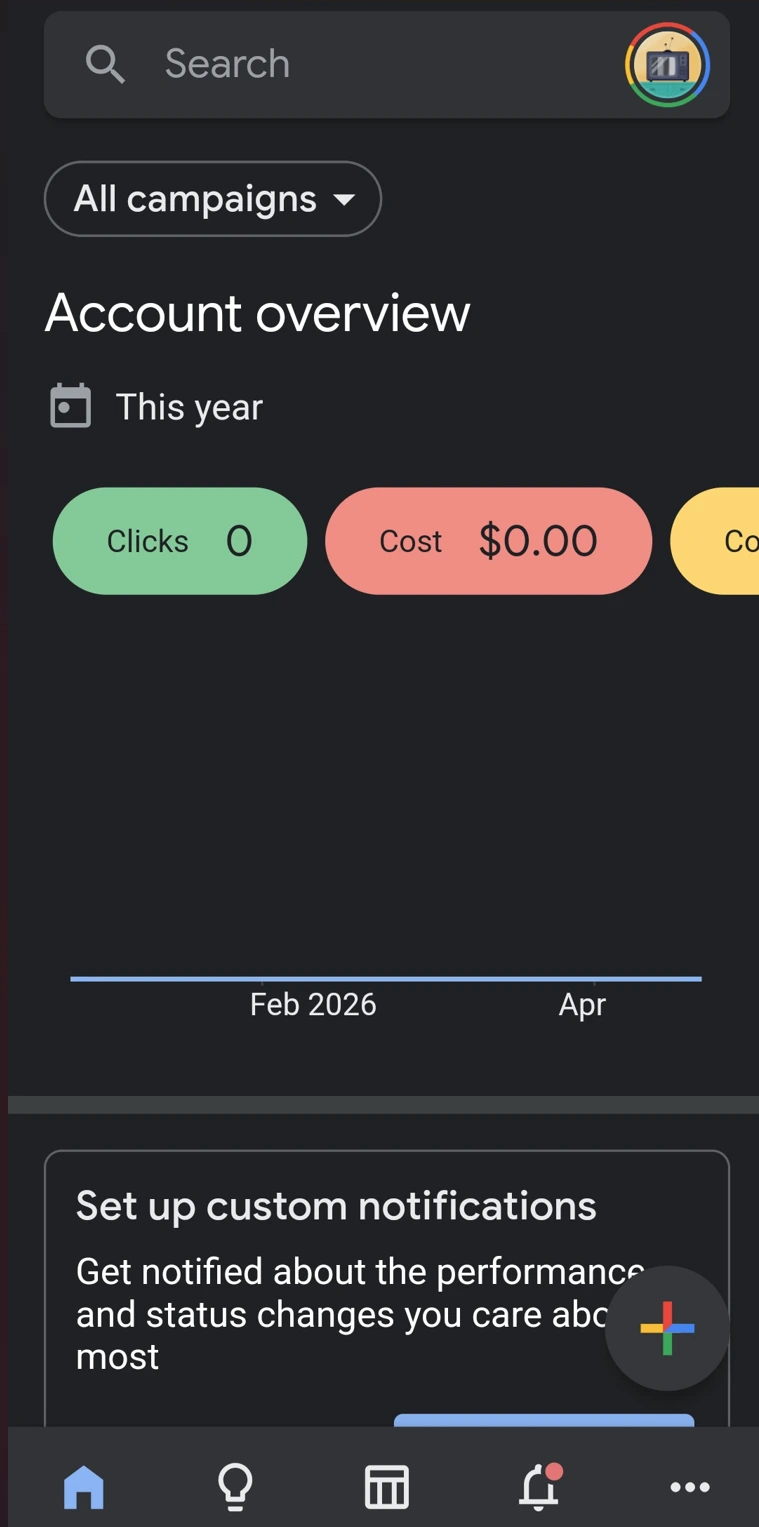
Google AI Overview result showing SetupTeam named as a recommended installation company — an example of what AI visibility looks like in practice
Google AI Overview naming a local business in the answer — run the live search to see one in action →

A real AI Overview naming a specific business in its answer — the kind of placement AI visibility work is aiming for.

Entity clarity — Can the AI resolve your business as a distinct entity? Not a keyword, not a guess. It needs to know your business is a real thing with a specific name, category, service area, and identity. Schema markup, consistent branding, and unambiguous descriptions feed this.

Structural clarity — Can the AI extract answers from your pages? Clear headings, answer-first content, specific FAQ sections, and tight service descriptions all make your content easier to summarize. Fluff content gets skipped.

Authority signals — Is your business referenced, reviewed, and cited across trusted sources? Reviews, directory listings, industry mentions, and backlinks from credible sites all contribute. AI systems treat consistent external validation as trust.

Consistency — Does your business information match across your website, Google Business Profile, directories, and review sites? When name, phone, address, and service area contradict each other across sources, the AI gets confused and defaults to a competitor whose data is cleaner.

* Results may vary based on your browser, location, search history, whether you're signed in, and Google's AI Overview rollout in your region. AI answers change over time as models update their source material.

Curious whether AI is naming your business right now?
Call us and we'll check a few queries live with you on the phone. Takes under 10 minutes.

AI Visibility vs. SEO

Same Foundation. Different Emphasis.

AI visibility and traditional SEO share a lot of groundwork. But the goal, the mechanics, and the signals that matter most are different enough that being good at one doesn't guarantee the other.

01

Different goal

SEO earns you a position in a ranked list of links. AI visibility earns you a citation inside an answer. One is about being findable; the other is about being chosen as the answer itself.

02

Different signals

SEO rewards backlinks, domain authority, and keyword alignment. AI visibility rewards entity clarity, structured data, citation consistency, and whether the content can be cleanly summarized. The overlap is real but partial.

03

Different time horizons

SEO rankings can take 6–12 months to shift. AI citations can update in 30–90 days as AI models re-index their source material. Good news if you're starting from behind. Bad news if you're not paying attention.

The two disciplines aren't opposed. Most of the technical foundation — clean site architecture, fast load times, crawlable content, authoritative writing — benefits both. The divergence comes at the top of the stack: AI visibility adds a layer of entity structuring, citation management, and answer-oriented formatting that traditional SEO doesn't prioritize in the same way. You can learn more about how local businesses get recommended by AI tools if you want to go deeper on the mechanics.

What The Work Includes

What AI Visibility Work Actually Involves

Strip away the jargon and this is what the work looks like in practice. These five layers are the core of a real AI visibility build.

01

Entity structure

Schema markup, consistent NAP data, authoritative citations, and the structured signals AI systems use to resolve who your business is — including newer AI visibility files like llms.txt.

02

Content architecture

Service pages, location pages, and FAQ content written the way AI models actually parse information — answer-first, specific, and structured for extraction rather than padded for keyword density.

03

Google Business Profile alignment

Categories, services, reviews, and posts configured to reinforce the same entity signals your website carries. GBP remains one of the strongest trust inputs AI systems weigh for local businesses.

04

Citation consistency

Making sure your business name, phone number, service area, and description match across every directory, review platform, and data source AI tools reference. Mismatches get you skipped.

05

AI visibility tracking

Ongoing monitoring of whether ChatGPT, Gemini, Perplexity, and Google AI Overviews are actually naming your business for the queries that matter — and adjusting when they aren't.

Done right, this is compounding infrastructure. A well-structured page keeps earning AI citations long after it's published. That's the part that makes AI visibility feel different from the rental-economics of paid advertising — the asset keeps producing.

Why Now

Why AI Visibility Matters Right Now

The first-mover window on AI visibility is narrower than people realize.

SOCi's 2026 Local Visibility Index analyzed nearly 350,000 locations across 2,751 multi-location brands and found that only 1.2% of local businesses were consistently recommended by ChatGPT. Most categories are still wide open — but the early signals compound. AI systems lean on the entity signals they've already indexed, which means the businesses that show up early tend to keep showing up.

BrightLocal's 2026 consumer survey showed a 7.5x jump in AI search adoption for local services in a single year — from 6% to 45%. That's the kind of step-change in consumer behaviour that happens a few times per decade. Every month a business isn't structured for AI extraction is a month a competitor is getting named for the searches their customers are running.

Late movers don't lose outright — but they do face a harder climb. Closing a structural-signal gap against a competitor who got cited first takes focused work, and the gap widens every month it's ignored.

The Proof

A Live Field Test of the Methodology

Before we offered AI visibility work to other businesses, we ran the methodology on our own operating business. The two screenshots below show what shifted.

Disclosure: SetupTeam is a service business operated by the same team behind MoreJobsLocal. The results below are what we observed during a live field test, not a neutral third-party case study.

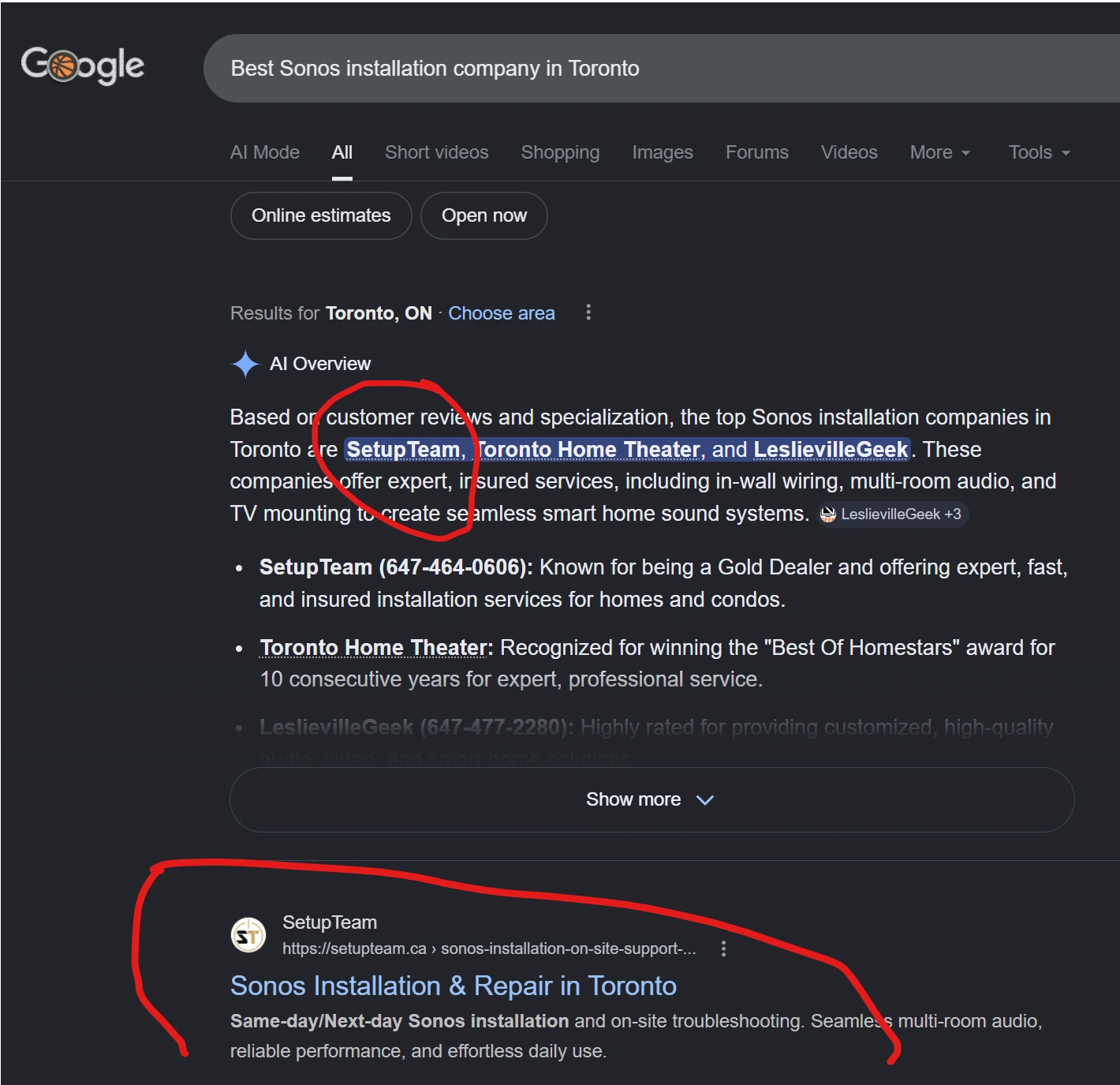
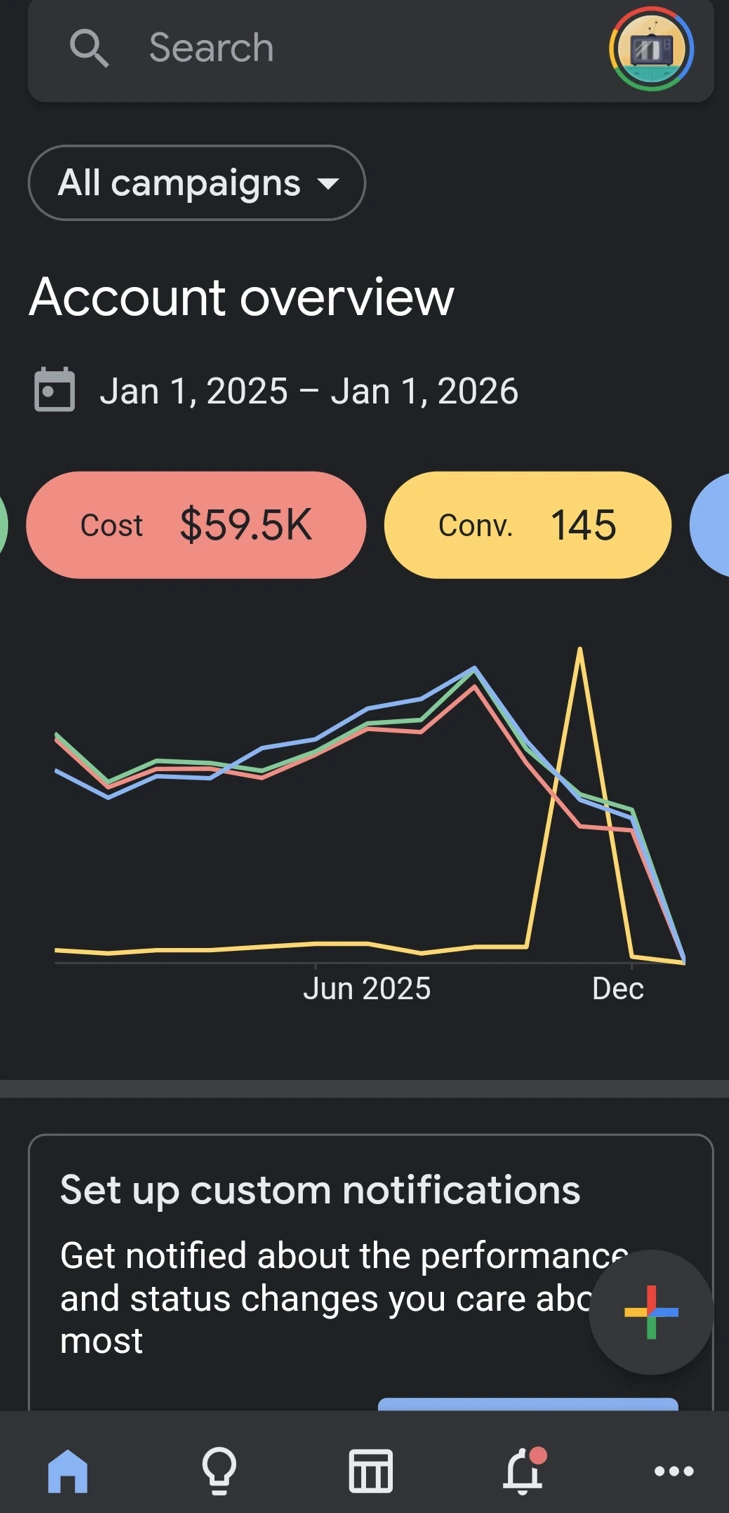
The two dashboards below are the same business, one year apart. The first shows what ad-dependent acquisition looked like before the AI visibility methodology was implemented. The second shows what the account looks like after the shift — with the business still booking jobs through AI-driven and organic channels instead.

The point isn't the exact numbers. The point is the direction of travel. When AI visibility is built correctly, a business doesn't need to rent every lead through paid clicks — because the AI tools are already naming it.

Google Ads dashboard from 2025 showing heavy spend on paid search before the AI visibility methodology was implemented
Before — heavy reliance on paid Google Ads to generate leads (2025 full year).
Google Ads dashboard from 2026 showing zero paid spend after shifting to AI visibility-driven lead generation
After — $0 paid spend in 2026 year-to-date, with jobs coming through AI-driven and organic channels.

* Every business is different. Most businesses shouldn't aim for zero ad spend — ads still earn their keep for seasonal and emergency categories. The methodology validates that AI visibility can carry the majority of lead flow when it's built correctly, not that paid advertising disappears overnight.

That field test is why we're confident about the mechanics we describe on this page. The same structural signals that made AI tools start naming SetupTeam — entity clarity, clean schema, consistent citations, answer-first content — are the ones we now build for other local businesses. If it doesn't produce results on a real operating business, we don't offer it to anyone else.

If you want to understand how this looks in a specific market, our AI visibility services for Toronto page walks through what a local build involves for contractors and service businesses in the GTA. If you want to see what a good-looking presence on Google Maps requires, the companion piece on Google Maps ranking for service area businesses covers that layer.

Want a plain-language read on where your business stands?
The free audit takes an hour and shows you which AI tools cite you, which cite your competitors, and what the structural gap is.

Who It's For

Who Actually Benefits From AI Visibility Work

Not every business needs this today. A few clear signals tell you whether the work pays off soon or whether you can wait.

01

Customers already use AI to research

If the people you serve are the kind of customers who ask ChatGPT, Gemini, or Perplexity for recommendations before they call, AI visibility is already shaping your pipeline — whether you're part of it or not.

02

Competitors are already being cited

Run the searches your customers would run. If three competitors appear in AI answers and you don't, the cost of staying invisible is rising every month. This is usually the strongest "now, not later" signal.

03

You rely on local or service queries

AI tools are especially active in local service categories because those queries are recommendation-shaped ("best X near me," "reliable Y in [city]"). Service-area businesses feel the shift first and hardest.

If none of those apply yet — if you're in an unusually niche category where nobody's getting AI-cited — you have more room to wait. But that window is closing in most local service categories, and the businesses that move first tend to hold their position longer.

How We Approach It

How MoreJobsLocal Handles AI Visibility

Foundational AI visibility work starts at $449.99 per month. Pricing scales based on the size of your site and scope of work after the initial engagement.

Every engagement starts with a free audit of:

  • Whether AI systems currently cite your business for any relevant queries
  • What your competitors are getting cited for instead
  • Where your Google Business Profile, website, and citations are leaking signal
  • Which structural fixes would produce the most visible change, and which are lower priority

We tell you what we'd do, how long it would take, and what a realistic outcome looks like. No lock-in, no 12-month contracts, no "results guaranteed." Results vary — they always do — but we'll show you what we've observed and let you decide whether it fits.

Our focus is deliberately narrow: AI visibility, local SEO, and Google Maps work for local businesses and tradespeople. We don't sell e-commerce growth, enterprise content programs, or generic digital marketing retainers. The narrower focus is what lets us keep the work actually effective.

FAQ

Frequently Asked Questions

AI visibility is how often and how accurately your business appears inside answers generated by AI tools like ChatGPT, Google Gemini, Google AI Overviews, Perplexity, and Microsoft Copilot. Instead of ranking on a page of blue links, AI visibility is about being one of the two to four businesses an AI system names when a user asks for a recommendation. It's measured by mentions, citations, the accuracy of how your business is described, and how consistently you appear across repeated queries.
Traditional SEO aims to rank your pages in Google's list of results. AI visibility aims to get your business named inside the answer itself, before the user ever sees a list of links. The two share a foundation — clean site structure, authoritative content, fast load times — but they diverge in emphasis. AI visibility leans harder on entity clarity (does the AI know who you are as a distinct business?), structured data, consistent citations across the web, and answer-first content. A site can rank well on Google and still be absent from AI answers for the same query if the AI can't extract a clear, trustworthy picture of the business.
AI systems evaluate four main signals. First, entity clarity — can the AI resolve who your business is as a distinct entity, not a keyword? Second, structural clarity — is your website organized in a way the model can extract answers from (headings, FAQs, schema markup)? Third, authority signals — are you referenced, reviewed, and cited across trusted sources? Fourth, consistency — does your business information match across Google, your website, directories, and review platforms? When those four signals align, the AI can cite your business with confidence. When they don't, it defaults to a competitor whose signals are cleaner.
BrightLocal's 2026 Local Consumer Review Survey found that 45% of consumers now use AI tools to find local services, up from 6% the year before. At the same time, SOCi's 2026 Local Visibility Index — which analyzed over 350,000 business locations — found that ChatGPT currently recommends only 1.2% of local businesses. That's a winner-take-most structure. When an AI system names two or three businesses in response to a local query, every other business in the category is invisible to that customer. For local operators, AI visibility is the difference between being in the conversation and being replaced in it.
The foundation is entity structure — schema markup, consistent NAP (name, address, phone) data, authoritative citations, and the structured signals AI systems look for when deciding which business to name. On top of that sits content architecture (service pages, location pages, FAQ content written the way AI models parse information), Google Business Profile alignment, review strategy, and ongoing monitoring of whether ChatGPT, Gemini, Perplexity, and Google AI Overviews are actually naming the business for the queries that matter. Good AI visibility work is not a one-time tweak — it's infrastructure that keeps earning citations after the initial build.
They're closely related terms. AI visibility is the outcome — whether AI tools name your business. Generative engine optimization (GEO) is the practice of shaping content and signals so generative AI systems include you in their answers. Answer engine optimization (AEO) is a narrower framing focused on answer boxes and AI-generated summaries. In practice, most of the work overlaps. Different agencies use different labels. What matters is the outcome: when a customer asks an AI tool for a recommendation in your category, does your business get named, and is the description accurate.
Yes, and this catches a lot of business owners off guard. Good Google rankings mean Google's algorithm trusts your pages for specific keywords. AI systems weigh different signals — entity clarity, citation consistency, structured data, and how cleanly the content can be extracted and summarized. A site with strong backlinks and a #1 ranking can still be passed over by ChatGPT or Gemini if the AI can't build a confident picture of who the business is. SOCi's 2026 data found that in retail, only 45% of brands ranking well on Google appeared in AI recommendations at all. The Venn diagram overlaps but isn't a circle.
Foundational work — schema implementation, GBP alignment, content restructuring — typically starts influencing Google Business Profile and Maps visibility within 4 to 8 weeks. ChatGPT and Gemini citations tend to lag, often 8 to 16 weeks before consistent mentions appear, because AI models update their indexed source material on their own schedules. Less competitive niches move faster; saturated ones take longer. Anyone promising guaranteed AI visibility in 30 days is either overselling or operating in a category where nobody else has shown up yet.
Significantly. ChatGPT, Gemini, and Google AI Overviews all lean on review signals when deciding which local business to name. Volume, recency, and sentiment all feed into the decision. Businesses with strong, sustained review flows on Google, Yelp, and category-specific platforms are far more likely to be cited. Review strategy isn't a separate layer bolted onto AI visibility work — it's core infrastructure. Each new review is another data point the AI uses to decide whether to name you.
Open ChatGPT, Gemini, and Perplexity one at a time. For each one, ask a question a customer might ask: "who's the best [your service] in [your city]?" or "recommend a [service type] near [area]." Try five or six variations — single-service, service-plus-city, "near me" phrasing, "top-rated" variants. If your business name appears consistently, you have some AI visibility. If it appears occasionally, you're close but unstable. If it doesn't appear at all, you have none. The answers you get roughly mirror what your customers are getting, with some variability based on location and account signals.

Find Out Where You Currently Stand

The free audit is exactly what it sounds like. We look at your Google Business Profile, your site structure, your citation footprint, and whether AI systems are currently naming your business for the queries that matter. We tell you what we'd fix, what it would cost, and what a realistic timeline looks like. If the gap is small, we'll tell you. Either way, you walk away knowing more than when you started.