Trades and home services
Plumbers, HVAC, electricians, roofers, and emergency repair. Highest-leverage category — buyers want a name, not a list. AI tools collapse the decision to one or two recommendations and the call goes there.
A scene from a Tuesday night in Unionville
Three names showed up in Markham. Yours wasn't one of them. It's 11:47 p.m. A homeowner near 16th and Kennedy has water coming up through the basement floor. They open ChatGPT — not Google — and type: "emergency plumber near me Markham." Three businesses get named in the answer. The call goes to one of them. If you run a plumbing company in this area, the question worth asking is why you weren't on that list.
Serving Markham, Unionville, Thornhill & the GTA · Free audit
Pattern Behind the Three Names
It wasn't reviews. Two of them had fewer than businesses that didn't show up. It wasn't ad spend. None of them ran Google Ads that night. It wasn't even a top-three Google Maps ranking — one was buried at position seven.
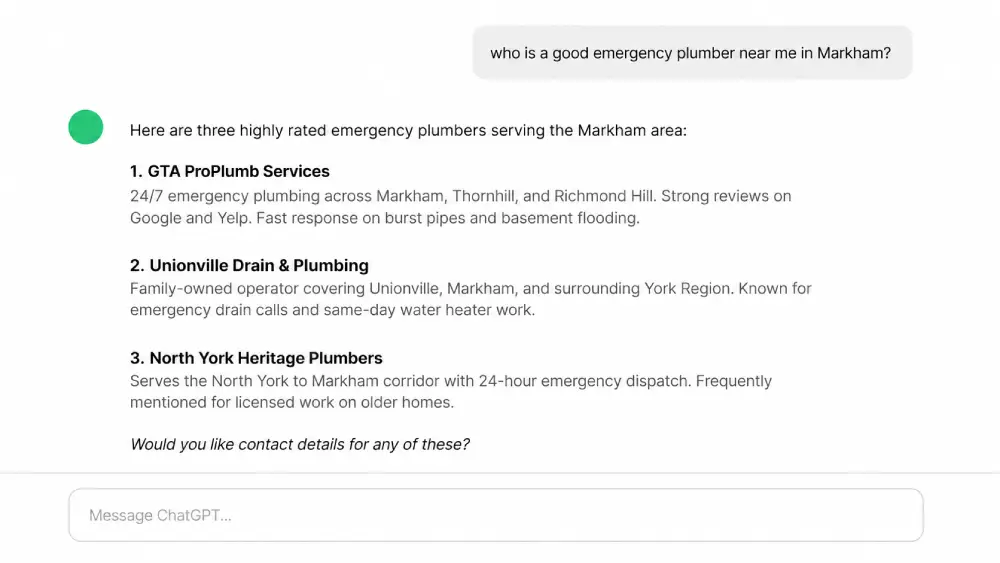
What they had in common was something more boring and more powerful: their information was the same everywhere it appeared. Same business name across Bing Places, Google Business Profile, Yelp, and their own website. Same service area. Same phone format. Same hours. Schema markup on the website that matched what was visible on the page. A handful of consistent third-party citations.
That's the thing AI tools quietly punish: businesses where the data disagrees with itself. ChatGPT, Gemini, Perplexity, and Copilot don't have time to reconcile your story across twelve sources. If they read three versions of you, they pick the one that looks confident, named everywhere, and uncontested. Then they recommend that business and skip the rest.
AI tools don't just rank businesses. They check whether a business is the same business across every place it appears.
The Overlap Zone
Service businesses in Markham operate in an awkward overlap zone. A plumber based near Highway 7 might pull jobs south into Scarborough, west into Vaughan, north into Aurora, and east toward Pickering. A dentist in Unionville competes with practices in Thornhill, Richmond Hill, and downtown Toronto for the same patient pool.
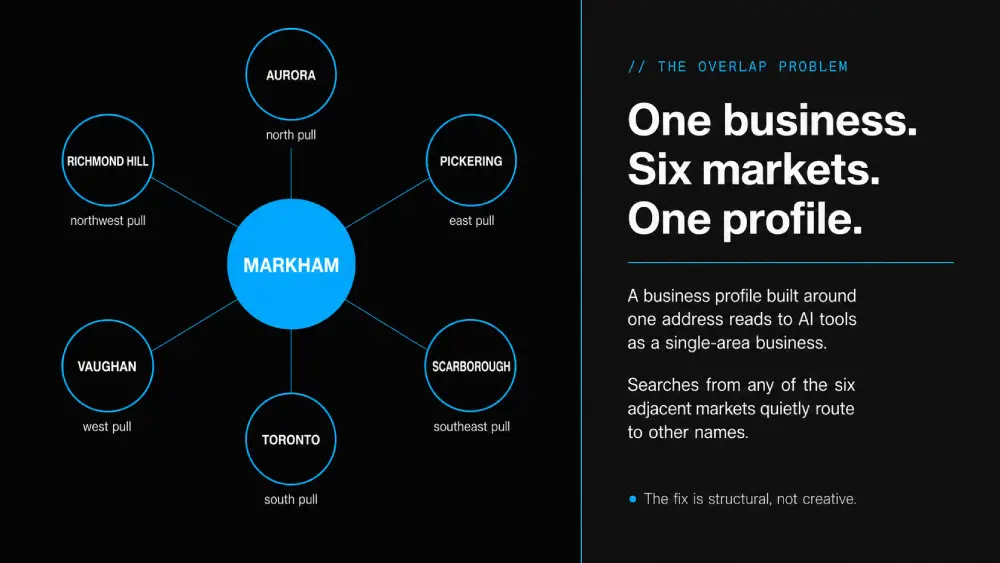
That overlap is the part most owners get wrong. They build a website and Google profile around their physical address — one city, one location, one neighbourhood. AI tools then read them as a single-area business and skip the recommendation when someone searches from an adjacent area, even if the business actively serves there.
Fixing this is mechanical, not creative. The website has to spell out service geography in a way an AI tool can parse on first read. Schema has to confirm it. Bing and Yelp have to match. The fix takes a week of work, but most owners never know they need it because their Google Maps numbers look fine and the lead loss is invisible — calls that simply never come in.
5-Minute Diagnostic
Before booking any audit, Markham business owners can run these five checks themselves. They take about five minutes total and will tell you whether you have surface-level problems (fixable in-house in a weekend) or deeper structural problems (where outside help saves time).
What you're looking for: Are you named? Are competitors you didn't expect named? If specific competitors come up repeatedly across slightly different prompt wordings, those are your real AI-visible competitors — not necessarily the same ones you see on Google Maps.
What you're looking for: Does the listing exist? Is it claimed? Is the address, phone, and category correct? Unclaimed or stale Bing listings are common among small businesses. ChatGPT and Copilot rely heavily on Bing data. A missing or wrong Bing listing is a silent hole.
What you're looking for: Do you see a JSON-LD block? Does it include a LocalBusiness type, your address, your phone, and your service area? If schema is missing entirely, AI tools have to guess what your site is about. If it's there but vague, they'll guess wrong about half the time.
What you're looking for: Does a listing exist? Is it claimed? Yelp matters less for human traffic in Canada than in the US, but AI tools weight it heavily because their training data is US-skewed. A claimed Yelp listing with even a few reviews moves the needle more than its traffic numbers suggest.
What you're looking for: Are there old listings with a previous address, a different phone number, an old business name, or a closed location? Stale citations across forgotten directories drag your AI confidence score down. Each one is a small contradiction in your story, and AI tools notice.
If all five checks come back clean, the basics are handled — the harder visibility work is in entity strategy, content structure, and how AI tools currently describe your business when asked directly. If any of them fail, that's where to start.
What the Self-Test Misses
Five-minute checks catch structural gaps. They don't catch the harder stuff. The deeper audit covers things owners can't easily test on their own: whether your business name is being confused with a similarly named business in the GTA, how AI tools currently describe what you do when asked specifically, whether your service-area pages reinforce or contradict each other, schema graph completeness across the whole site, and how you compare to the businesses actually being recommended in your category right now.
If you want the fuller version of the checks above — seven tests rather than five, each with explicit pass and fail criteria and a suggested order to fix things in — it lives on the free AI visibility check, which is written for any local service business rather than Markham specifically.
None of that is detectable from a homeowner-style spot check. It's detectable from running the same prompts dozens of times across different AI tools, comparing the responses, and then tracing the data each tool used to construct its answer. That work takes hours, not minutes.
Where It Matters Most
In Markham, some categories have more to gain from AI visibility than others. The pattern: high-intent, near-immediate decisions, short answer formats. Anything where someone wants a name and a phone number, not a comparison shopping list.
Plumbers, HVAC, electricians, roofers, and emergency repair. Highest-leverage category — buyers want a name, not a list. AI tools collapse the decision to one or two recommendations and the call goes there.
Family dentists, optometrists, chiropractors, walk-in clinics. AI tools weight reviews heavily here, and they cross-check with directories like RateMDs. Single-platform review concentration hurts more in this category than most.
Commercial cleaning, property management, mechanical contractors, signage. Lower volume, longer sales cycles, but AI visibility surfaces the firm in shortlist research before the buyer ever calls. Often the deciding factor for who gets contacted first.
Accountants, lawyers, financial planners, IT consultants. AI tools are slower to recommend named individuals here for liability reasons but readily recommend firms. Firm-level entity clarity is the leverage point.
If you want the wider context, the parent AI visibility services guide explains the mechanics; the Richmond Hill, Toronto, and Vaughan pages cover the same approach for those nearby markets, and the deeper Richmond Hill audit example shows what a full audit actually looks like:
FAQ
We'll pull your rankings, speed score, and AI visibility and send your report in about five business days. No pitch unless you ask for one.