01
Keyword Research
Finding the actual terms potential customers use when searching for your services in your area. Not guessing — identifying real search patterns and the gaps competitors are not covering effectively.
// Organic SEO for Tradespeople Across Canada
Every click from Google Ads has a price. The moment you stop paying, the calls stop. Organic SEO works differently — it builds your position in Google's unpaid results through structure, content, and authority that compounds over time.
The work you put in today keeps getting you calls months and years from now, without an ad budget behind it.
Operator-built playbooks · Tested on our own service business first · No agency language
// What Organic SEO Does
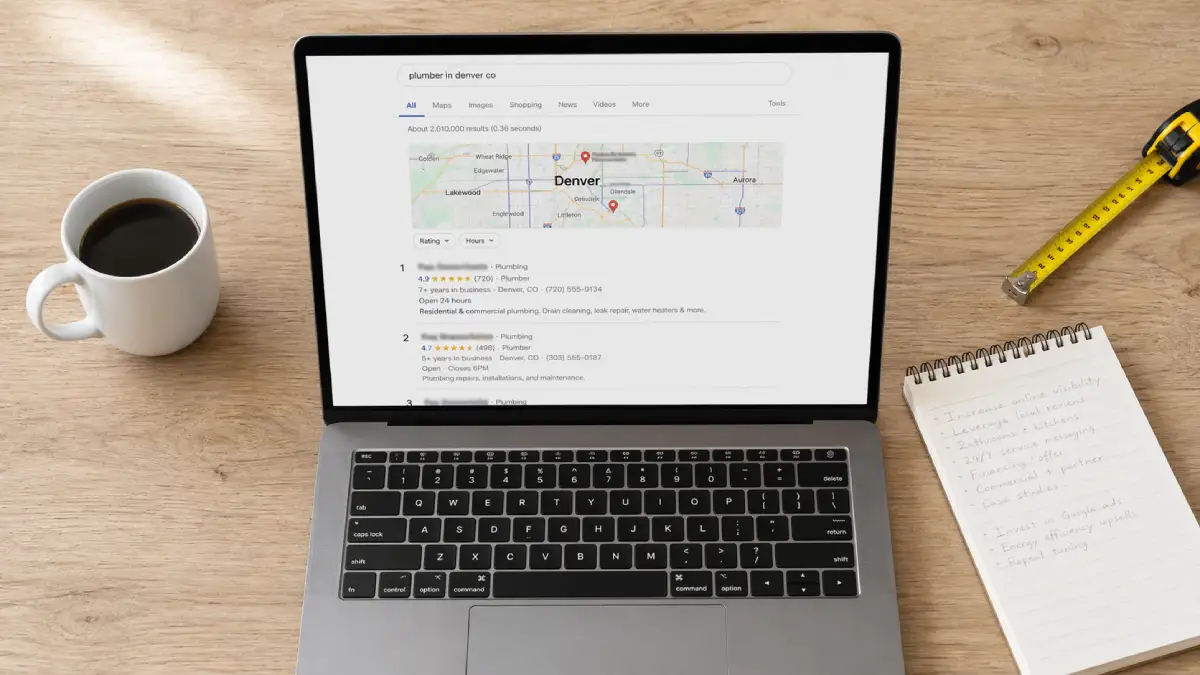
Organic SEO improves where your website appears in Google's standard search results — the non-paid listings below any ads at the top of the page. For a trades or home service business, this typically means showing up when someone searches "licensed electrician in Markham," "HVAC installation Richmond Hill," or "emergency plumber Ontario."
When a homeowner searches for a service you provide, in an area you serve, and your website appears in the top results — that is organic SEO working. They clicked a listing they perceived as credible, not an ad they recognized as paid. The difference matters: the first organic result on a Google search page receives an average click-through rate of 39.8%, compared to roughly 2% for paid ads in the same position (First Page Sage, 2025 — applies across industry categories including local service searches).
The practical outcome: organic rankings do not switch off when a budget runs out. A well-ranked page can keep your calendar full consistently for months or years without ongoing ad spend.
// What's Included
Organic SEO for a trades business covers several interconnected areas. These are not independent tasks — they work together, and a gap in any one area limits what the others can accomplish.
Finding the actual terms potential customers use when searching for your services in your area. Not guessing — identifying real search patterns and the gaps competitors are not covering effectively.
A dedicated page for each major service you offer. A plumbing business needs a separate page for drain cleaning, water heater installation, and emergency plumbing — not a single page that vaguely lists everything. Google ranks individual pages. Specificity wins.
A dedicated page for each city or area you serve. "Plumber in Markham" and "plumber in Vaughan" are different searches. Location pages give Google geographic context and help you appear in area-specific results that a generic homepage cannot rank for.
Titles, headings, meta descriptions, internal links, and image alt text — structured to tell Google exactly what each page covers and who it is for. Small details that collectively carry significant weight.
Page speed, mobile usability, crawlability, and schema markup that helps Google index your site correctly. A technically sound site is the foundation everything else builds on.
Google uses links from other websites as a trust signal — a vote that your business is credible and relevant. For a trades business, this typically means directory listings (HomeStars, BBB, Yelp, Canada411, trade-specific directories), community mentions, and supplier or partner links. Authority built this way is slow, but it is durable.
Blog content and page updates that build topical authority over time — answering the questions your potential customers are already searching for, in a way that adds genuine value and positions you as the trusted local expert.

// The Foundation
Most trades websites try to do too much on too few pages. A homepage that mentions every service and every city ranks well for none of them. Google needs clear, specific signals — one topic per page, handled well, supported by internal links that connect related content logically.
A properly structured organic SEO site gives every service its own page, every location its own page, and connects them through a logical architecture. When a homeowner in Richmond Hill searches for an HVAC contractor, the goal is a dedicated page that answers that specific query — not a homepage that broadly mentions serving the GTA.
This structural work takes time. It also holds. A well-built site based on specific, useful pages is significantly harder for a competitor to displace than a site built around keyword repetition on a handful of generic pages. Structure is the durable advantage.
// Timeline
The honest answer depends on your starting point and your market.
For most trades businesses in Canadian cities, early movement in rankings and search impressions is typically visible within 3 to 6 months of consistent work. Meaningful lead volume — calls and bookings from organic traffic — generally follows between 6 and 12 months. Google's own documentation notes that SEOs typically need four months to a year for improvements to take hold and deliver measurable benefit. Competitive markets — HVAC, plumbing, and electrical in the GTA — take longer than smaller Ontario or Alberta markets where the field is less crowded.
There are no shortcuts that last. Tactics that produce fast ranking gains through thin content or artificial link building tend to unwind, sometimes with ranking penalties that take months to recover from. A slow, properly built foundation is more durable and more valuable than a fast one built on shortcuts.
The practical approach most trades businesses use: run Google Ads while organic SEO is being built, then reduce ad spend gradually as organic traffic increases. The cost per call drops over time as the two channels balance out.
Want to know where your website actually stands? Start with a call — no pitch unless you ask for one.
Call (437) 799-0606// FAQ
We'll pull your rankings, speed score, and AI visibility and send your report in about five business days. No pitch unless you ask for one.