Contact Us

AI Visibility · Vaughan & Woodbridge

AI Visibility Vaughan: Get Found Where People Actually Ask

Someone in Woodbridge needs a plumber tonight. They don't open Google. They open ChatGPT and type, "who's a good plumber near me?" Three names come back. You're either one of them or you're not. That's what AI visibility is — and that's what this page is about.

We help trades, small shops, restaurants, car repairs, and growing local operators across Vaughan show up where people are searching now: ChatGPT, Gemini, Perplexity, and Google AI Overviews. Same approach works for the bigger players too — logistics, distribution, multi-location service businesses. The signals AI tools look for don't really care how big you are. They care if you're clear, consistent, and trustworthy.

Serving Vaughan, Woodbridge, Maple, Kleinburg, Concord & Thornhill  ·  Free audit
The Shift in Local Search

Local Search Already Changed. Most Vaughan Sites Haven't Caught Up.

Here's what changed: people stopped scrolling. A few years ago, finding a contractor meant typing a search, opening four blue links, comparing reviews, and picking one. Now a lot of people just ask. ChatGPT, Gemini, Perplexity, Google's AI Overviews — they read the question and hand back two or three names. No list of ten. No second page.

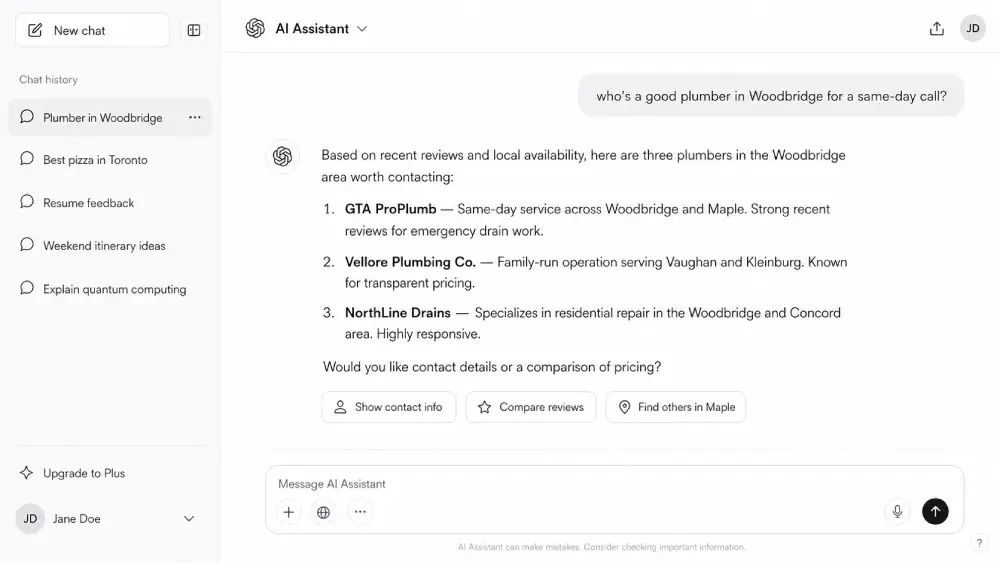
That sounds small. It's not. When AI tools only return three businesses for a query like "best electrician in Woodbridge", every slot matters more than a Google ranking ever did. You're either named or you're invisible.

AI assistant interface showing a recommendation of three Woodbridge area plumbers in response to a same-day service question
An AI assistant returning three named plumbers for a Woodbridge search — no list of links, no second page.

The shift is uneven. Older homeowners still use Google. Younger ones increasingly don't. Trades and home services in the Vaughan area are right in the middle of that change — which is why getting this right now, before everyone catches on, is one of the better local marketing moves you can make this year.

How Vaughan Actually Searches

Vaughan Doesn't Search Like One City

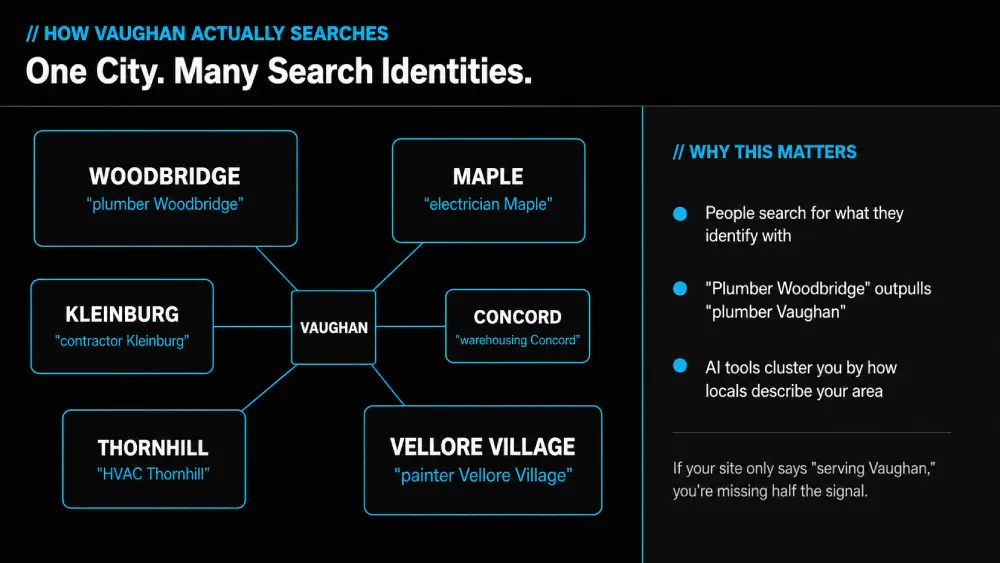
Most local SEO advice treats a city as one block. Vaughan doesn't work that way. Someone in Woodbridge thinks of themselves as being in Woodbridge. Someone in Kleinburg leads with Kleinburg. Maple, Concord, Vellore Village, Thornhill — same pattern. People search for what they identify with.

That's why "plumber Woodbridge" often pulls more local intent than "plumber Vaughan". It's not a quirk. It's how people actually live here. AI tools pick up on that too — they read patterns of how a business is described across reviews, listings, and websites, and they cluster you by where you actually serve.

Diagram showing Vaughan as six distinct neighbourhood search zones — Woodbridge, Maple, Kleinburg, Concord, Thornhill, and Vellore Village — each with its own local search pattern
People search for what they identify with. Each Vaughan neighbourhood carries its own local intent.

If your site only says "serving Vaughan," you're missing half the signal. The businesses that show up well in AI answers describe their service area the way locals describe their neighbourhoods.

Who This Is For

Who This Is Actually For

Most AI visibility content reads like it's written for tech companies. This isn't. We work with the people who run real local operations:

If you're in any of those buckets and you've felt the phone slow down, or you've watched competitors with worse work outrank you, that's the gap this fixes.

Plain Language

What AI Visibility Actually Means

AI visibility means your business shows up when someone asks an AI tool a question. That's it. Not a ranking on a search results page — a name in an answer.

The mechanics underneath are different from regular SEO, but the goal is simple. AI tools build their answers from a few sources: your website, your Google Business Profile, your reviews, your listings on places like Yelp and HomeStars, and mentions of your business across the rest of the web. They cross-check those sources. If everything lines up — same name, same phone, same services, consistent reviews, clear website — they trust you enough to recommend you. If things contradict each other or your site doesn't really say what you do, they skip you.

That's the whole game. Make it easy for an AI tool to understand what you do, where you do it, and that you're real and active. Most local sites fail at least one of those three.

The Four Signals

How AI Tools Decide Who to Recommend

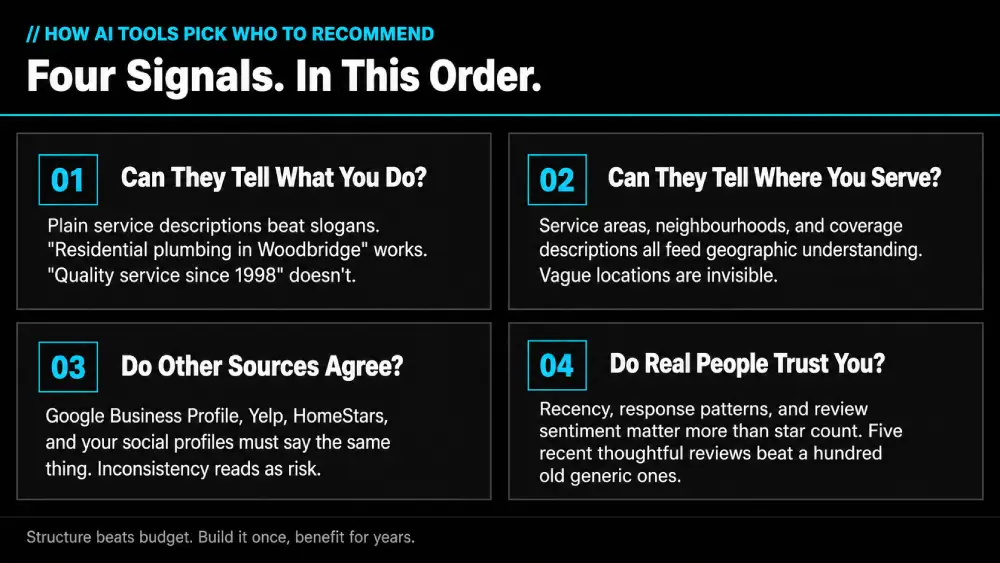
AI tools aren't flipping coins. They're looking at four things, in roughly this order:

  1. Can they tell what you do? Your website needs to say it plainly. "Quality service since 1998" tells an AI tool nothing. "Residential plumbing repairs and drain cleaning across Woodbridge, Maple, and Kleinburg" tells it everything.
  2. Can they tell where you serve? Service areas, neighbourhoods, the way you describe coverage — all of it feeds into geographic understanding. Vague is invisible.
  3. Do other places agree? Your Google Business Profile, your Yelp listing, HomeStars, your social profiles — they all need to say the same thing. Inconsistency reads as risk.
  4. Do real people trust you? Reviews matter, but the count matters less than people think. Recency, response, and language patterns matter more. Five thoughtful recent reviews beat a hundred old ones.
Diagram showing the four signals AI tools weigh when recommending a local business: clarity of services, clarity of service area, source consistency, and review trust signals
The four signals AI tools weigh, in roughly this order, when picking who to recommend.

None of this is luck. It's structure. And structure is something you build once and benefit from for years.

What We Build

What We Actually Build for You

Our work covers four areas. They're connected — fixing one without the others usually doesn't move the needle.

AI Visibility

We make your website readable to AI tools. Schema markup, clean entity signals, FAQ content that AI can extract, structured data that matches what's actually on the page. The goal: when someone asks Gemini for a contractor near Woodbridge, your business is one of the names it knows.

Maps Visibility & Reviews

Google Business Profile is the foundation. Most local operators have one — most have it half-set-up. We fix categories, services, service areas, photos, posts, and review response patterns. AI tools read GBP heavily when picking who to recommend, so this isn't optional.

Organic SEO

Regular Google search hasn't gone away. Most people still use it for a lot of queries. We build the page structure, content, and technical foundation that helps you rank for the searches your buyers actually run — neighbourhood-specific, service-specific, and the long, conversational questions people now ask.

Content Architecture

How your site is organized matters more than most people think. Service pages, location pages, internal links, FAQs — these are the bones AI tools and search engines read. We sort it out, or rebuild it if it's beyond fixing.

The Small-Operator Edge

Why This Works for Small Operators (Not Just Big Budgets)

Honest answer: AI visibility is one of the few things in marketing where small businesses can actually compete with big ones. Big chains have brand recognition. They don't always have clear, consistent, well-structured local data — which is exactly what AI tools weight.

A solo electrician with a clean Google profile, real reviews, and a clear website can outrank a national franchise in an AI answer. We've seen it. The franchise spent a fortune on ads. The electrician spent a few hours getting the basics right and a few months building reviews. Guess who Gemini names when someone in Maple asks for a recommendation.

That's not a guarantee — nothing in search is. But the ceiling is real, and it's lower-cost than most other marketing.

If you want the wider context, the parent AI visibility services guide explains the mechanics; the Toronto and Richmond Hill pages cover the same approach for those markets, and the Google Maps ranking guide for service area businesses goes deeper on the maps side:

FAQ

Frequently Asked Questions

Yes, small businesses show up regularly. AI tools don't rank by company size — they rank by how clearly you can be understood. A two-person operation with a clean Google Business Profile, consistent listings, and a website that plainly says what it does will often outperform a national chain with messy local data. The barrier isn't budget. It's structure.
Usually two to four months before AI tools consistently recognize and recommend you. Sometimes faster if your foundation is already half-built. Anyone promising results in two weeks is guessing. The reason it takes time is that AI tools cross-reference your information across many sources, and those sources need time to update and align.
Partly. The technical foundation overlaps a lot — schema, content quality, site structure, reviews. What's different is what gets weighted. AI tools care more about clear entity signals, structured answers, and consistency across the web. Regular SEO still matters because most people still use Google. The two work together, not against each other.
Both, but lead with the neighbourhood. People in Woodbridge, Maple, Kleinburg, and Thornhill identify with their community before the city name. That's how they search. We build pages and signals that cover both, but the neighbourhood-specific keywords often have stronger local intent and less competition.
No. Nothing in marketing guarantees leads, and anyone telling you otherwise is selling you something. What AI visibility does is make sure you're in the room when an AI tool answers a relevant question. The phone call is still up to your reviews, your pricing, and how you handle the inquiry. We get you to the shortlist. The rest is your business.
Not fancy — clear. AI tools don't care about animations or design awards. They care that your site says what you do, where you do it, who you help, and how to reach you. A simple, well-structured five-page site usually outperforms a complicated one. If your current site is genuinely broken or vague, we'll rebuild it. If it just needs sharpening, we sharpen it.
Yes. The signals are the same: clear listings, consistent information, real reviews, a website that says what you do. A pizza place, a car repair shop, a hair salon, a small retailer — they all benefit from the same approach. The specific tactics vary by category, but the foundation is identical.
Same principles, different application. B2B buyers increasingly use AI tools to build shortlists for procurement. If a logistics manager asks Gemini for warehousing options near the GTA, the companies with clear service descriptions, structured data, and consistent online presence get named. The work is more technical for B2B because the audience expects more depth, but the foundation is the same.
They matter a lot, but not in the way most people think. AI tools don't just count stars — they read sentiment, recency, and how you respond. Five recent thoughtful reviews with real owner responses outperform a hundred two-year-old generic ones. Asking past customers for honest reviews regularly is one of the highest-leverage things you can do.
We check how AI tools currently see your business. That includes your website's entity signals, schema markup, Google Business Profile setup, listing consistency across major directories, review patterns, content gaps, and how you compare to similar operators in your area. You get a written report with specific fixes ranked by impact. The audit is free.
Stuffing your city name everywhere, buying cheap backlinks, or running schema markup that contradicts what's on your page. All three actively hurt you. AI tools and search engines penalize over-optimization more than they used to. If your site reads like it was written for keywords instead of people, that's a problem.
Maybe, maybe not — depends on your business and how fast you need leads. AI visibility and organic search are slower to build but cheaper long-term. Ads are immediate but stop the day you stop paying. A lot of operators run both: ads for short-term flow, organic and AI work for the foundation that compounds over time. We can help you think through the mix without pushing you into either.

See Where You Actually Stand

The audit takes us a few hours. You get a written report with specific fixes — not a sales pitch. If we can help, we'll say so. If you don't need us, we'll tell you that too.

Most local websites fail at least one of the three things AI tools check first. Find out which one is yours.