Contact Us

Local SEO for Service Businesses Across Canada

Service Area Business Google Maps Ranking — The No-Storefront Problem

No storefront. No pin on the map. No problem — if you understand what actually controls your visibility and build accordingly.

Most Canadian tradespeople and home service businesses are fighting for Maps visibility with one hand tied behind their backs. This page explains exactly why, and what a properly structured SAB presence looks like in 2025 and beyond.

Operator-built  ·  Documented results  ·  $0 upfront  ·  Canadian businesses served

The Core Problem

The Real Problem with No Storefront

Google Maps was built around physical locations. Service area businesses are fighting on a tilted field — but not a lost one.

If you run a trade or home service business in Canada — plumbing, HVAC, electrical, roofing, landscaping, cleaning — you go to your customers. No front door. No sign. No waiting room. Just a truck and a service area that might span an entire city or region.

Google does allow service area businesses to hide their address and define a coverage zone, but that does not put you on equal footing with the competitor who has a shopfront three blocks from the searcher in Mississauga, Barrie, or Calgary.

Here is what most SABs get wrong: they assume that adding more cities to their service area settings expands their ranking range. It does not. The service area you list in your Google Business Profile does not affect your ranking. Your visible radius is anchored to the address you used to verify the listing — and hiding that address from the public does not hide it from Google's proximity calculations.

That is the core of the no-storefront problem. Not that you cannot rank — you can. But you are competing on a tilted field, and the only way to win consistently is to understand which signals you actually control.

Proof / Maps Grid

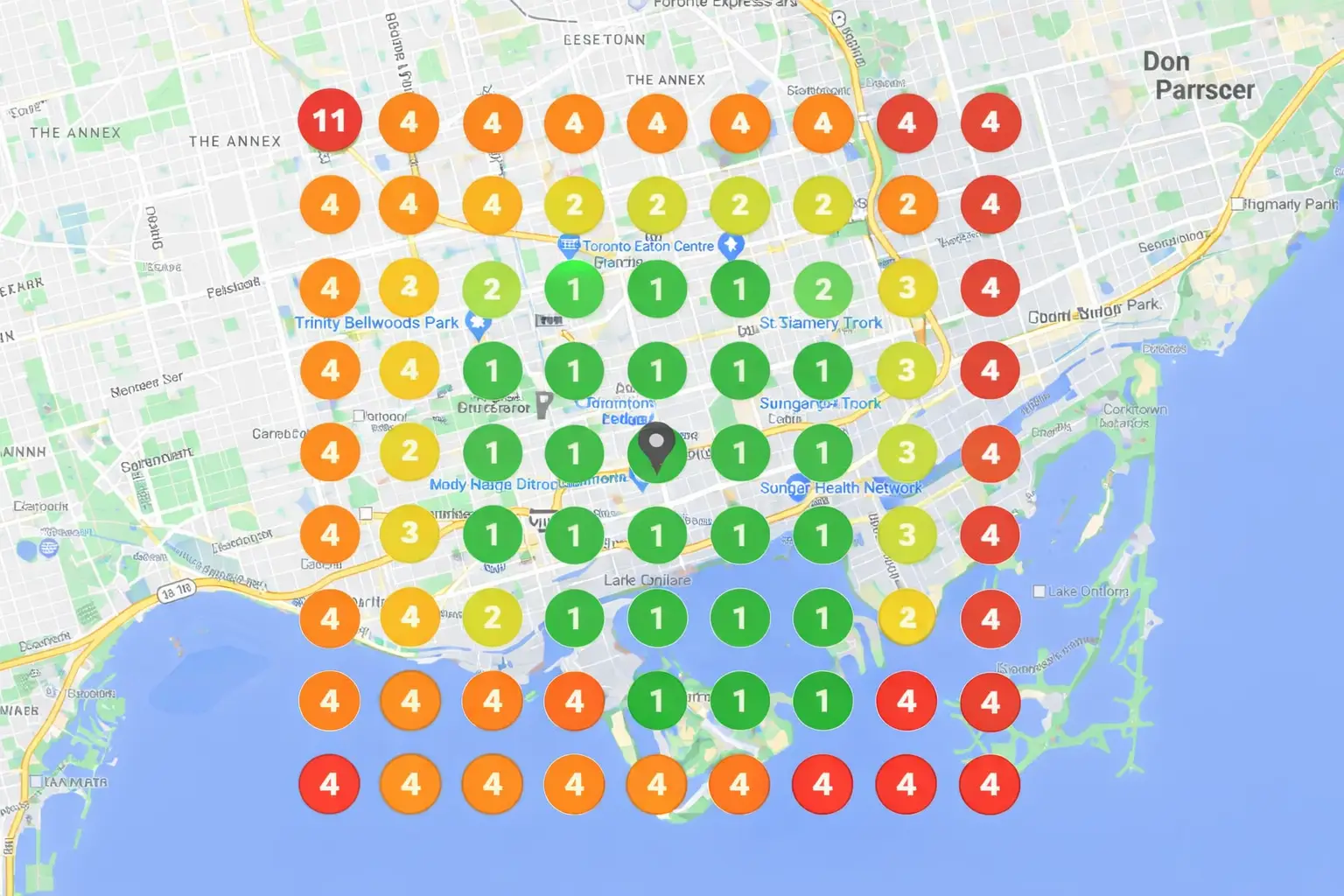
What the Maps Grid Actually Shows

Green = ranking in the 3-pack. Red = not appearing. The pattern is always the same — strong near the verified address, weaker at the edges.

Google Maps ranking heatmap grid for a Toronto service area business showing strong visibility near verified address and declining coverage toward city edges
Maps grid for a GTA-based SAB. The verified address is in the north end — visibility drops sharply south and west, despite active coverage across the full area.

For service area businesses, the pattern is consistent: strong visibility near the verified address, weakening results as distance grows, and often no visibility at all past a certain radius — even in areas the business actively serves and has listed in their profile.

This is not a setup error. It is how the algorithm behaves. A business with a GTA address will typically show strong Maps presence in a ring around that location. Rank well in North York but invisible in Etobicoke. Competitive in Mississauga East but absent in the west end — even if the crew is there every day.

Understanding this map is the starting point for every SAB strategy we build. It tells you where you are competitive right now, where proximity is the ceiling, and where relevance or prominence gaps are the actual problem.

How Ranking Works

The Three Signals That Control Your Ranking

Google's local algorithm evaluates every business on relevance, proximity, and prominence. For SABs the strategy differs — because proximity is harder to control.

01

Proximity

Google calculates your distance from the searcher using your verified address — even when that address is hidden from the public. You cannot change this by editing service area settings. You can only work around it by building stronger relevance and prominence signals where proximity alone would not win.

02

Relevance

Relevance is how clearly Google understands what you do and where. It is built through alignment between your GBP category and services, your website's service pages, and location-specific content. A plumber in Hamilton whose site clearly covers Hamilton, Burlington, and Stoney Creek will outperform a competitor with a vague, location-neutral site — even at similar distances.

03

Prominence

Prominence is how trusted and well-known your business appears online. For SABs without a storefront, this is often the deciding factor in competitive Canadian markets. It is built through reviews, citation consistency, website authority, and local engagement signals that tell Google your business is active and real.

Not sure which signal is holding you back? A free audit identifies exactly where the gap is — proximity ceiling, relevance problem, or prominence deficit.

Book a Free Audit

The Foundation

What a Properly Structured SAB Presence Includes

Getting the foundation right matters more than any tactic. Five components, each non-negotiable in the Canadian market.

01

Google Business Profile

Configured correctly as an SAB — address hidden if you work from home, service areas set accurately, primary category chosen with precision (not the broadest option), and services listed in full. The primary category carries significant weight for relevance. Picking the wrong one costs rankings.

02

Consistent NAP

Your business name, phone number, and service description should match across every directory — Google, Yelp, HomeStars, Canada411, and trade-specific directories relevant to your category. Inconsistency weakens the trust signals Google uses to confirm you are a real, operating business.

03

A Website That Supports the Profile

Your homepage should clearly state what you do and where. Individual service pages should cover each offering with real, useful content — not thin placeholders. Location pages for the cities you actually serve give Google geographic context and help you appear where proximity alone would not win.

04

Reviews — Volume, Recency, Detail

Reviews carry more weight for SABs than for storefronts, because customers cannot visit to form an impression. Reviews mentioning the service, the city, and the experience reinforce keyword relevance alongside trust. Businesses ranking in competitive Ontario and Alberta markets collect reviews steadily — not in bursts.

05

Schema Markup

LocalBusiness or trade-specific schema on your website helps Google understand your business type, service area, and category clearly. It also supports visibility in AI-generated answers — which increasingly surface local business information before a user clicks anything.

The Missing Signal

AI Search Visibility — The Signal Most SABs Miss

In 2025, Maps is no longer the only surface that generates leads. AI answers are increasingly the first — and sometimes only — result a searcher sees.

AI-powered search — Google's AI Overviews, ChatGPT with browsing, Gemini, and Perplexity — is now answering questions like "best HVAC company in Mississauga" and "electrician near me reviews" directly in the response, without the user clicking a traditional search result at all.

The businesses that get named in those answers are not always the ones at the top of the Maps pack. They are the ones with the clearest, most structured information about what they do, where they work, and why customers trust them — available in a format AI systems can extract and cite.

This is where MoreJobsLocal's approach differs from a standard local SEO setup. We build for both signals simultaneously: Maps visibility through profile, prominence, and proximity strategy, and AI visibility through content structure, schema, and the entity signals that get a business named in generated answers.

For a service area business competing across a metro market, this matters. A strong AI answer mention can generate leads from areas where you are not winning the Maps pack — because the searcher never opened Maps at all.
What Not To Do

Why Shortcuts Create Long-Term Problems

Virtual offices, duplicate profiles, bought reviews. Quick wins that quietly unwind — and the reinstatement process is slow, inconsistent, and not guaranteed.

Google has become significantly stricter about GBP verification and is better at identifying manufactured signals. Profiles that look legitimate but are not tend to get filtered quietly — they stop appearing in the map pack results that matter, with no obvious indication why.

A clean, well-structured presence built on a real location, real reviews, and real website content holds. It grows steadily. It does not disappear after an algorithm update or a policy enforcement sweep.

The businesses ranking consistently in competitive Canadian SAB categories — trades in the GTA, home services across Ontario, contractors in Vancouver and Calgary — are generally the ones who built correctly over time.

FAQ

Frequently Asked Questions

Yes. Google allows service area businesses to hide their address and still appear in Maps results. Your verified location is still used internally for proximity calculations — hiding the address affects what users see, not how Google evaluates your distance from a searcher.
No. Service area settings show users your coverage on the map but do not affect your ranking. According to Sterling Sky's research on SAB ranking factors, Maps rankings for service area businesses are based on the address used to verify the listing, not the service areas listed in the profile.
Almost certainly proximity. If their verified address is closer to where the search happened, Google gives them a proximity advantage that can outweigh review count. The gap matters more in dense markets like the GTA, where businesses with different postal codes can compete in the same commercial corridor.
This violates Google's guidelines and carries real risk. Google requires that a GBP address be a location where the business is genuinely staffed and reachable during stated hours. Virtual offices and mailbox addresses result in profile suspensions — often quietly, without warning. The short-term gain is rarely worth the loss of the listing.
Maps ranking determines whether you appear in the local 3-pack when someone searches on Google. AI search visibility determines whether your business gets named in AI-generated answers — Google AI Overviews, ChatGPT, Gemini — when someone asks a question about services in your area. Both matter for lead generation. A growing share of local searches now resolve in an AI answer without the user ever clicking into Maps results.
It depends on your city and category. In smaller Ontario or Alberta markets, 20 to 40 detailed reviews may be competitive. In dense GTA markets for high-demand trades — HVAC, electrical, plumbing — top-ranking SABs often have 80 to 200 or more. More important than raw count is recency and consistency. A listing that earned 60 reviews two years ago and none since looks less active than one collecting reviews steadily each month.

Find Out Where Your Visibility Actually Stands

If your service area business is not showing up where it should across your market, the fix starts with understanding why — not guessing at it. We audit your GBP, website alignment, review signals, citation consistency, and AI visibility profile. You get a clear breakdown of what is working, what is missing, and what to fix first.