How to Get Your Local Business Recommended by AI — And How We Did It on Our Own Company in Under a Year
45% of customers now find local businesses through AI tools — and 98.8% of businesses don't appear. A documented field test on SetupTeam — our own AV company — from invisible to AI-recommended in under a year.
Quick answers
How do I get my business to show up in AI recommendations?
Your business needs consistent information across Google, strong recent reviews, service pages that answer real questions in plain language, and schema markup that AI tools can read. Businesses that have all four appear in AI recommendations. Those that skip them usually don't.
Does Google SEO help me appear in ChatGPT or Perplexity?
Not directly. Ranking on Google does not automatically make you visible to ChatGPT, Perplexity, or Gemini. These platforms evaluate your business separately — based on review quality, content clarity, and how consistently your information appears across the web.
How fast can a local business start appearing in AI results?
Most businesses begin seeing AI citations within 4 to 8 weeks of making the right changes. Results vary by starting point — a business with no reviews and an outdated website will take longer than one with a solid foundation.
Is AI search actually being used by real customers?
Yes. 45% of consumers now use AI tools to find local services — up from just 6% one year ago, according to BrightLocal's 2026 Local Consumer Review Survey. That shift happened in a single year.
What kind of local businesses get recommended by AI?
AI tools consistently recommend businesses with above-average Google ratings (4.0 stars or higher), recent and detailed customer reviews, service-specific pages on their website, and structured data markup. Businesses without these signals are invisible to AI regardless of how long they have been operating.
The Problem Most Local Business Owners Don't Know They Have
Your business might not exist in AI's world.
Not because you did anything wrong. Not because your reviews are bad or your service is poor. Simply because AI tools — ChatGPT, Perplexity, Gemini, Google's AI Overviews, and voice assistants like Siri — read the web differently than traditional search engines do. Most local business websites were built for Google 2015, not AI 2026.
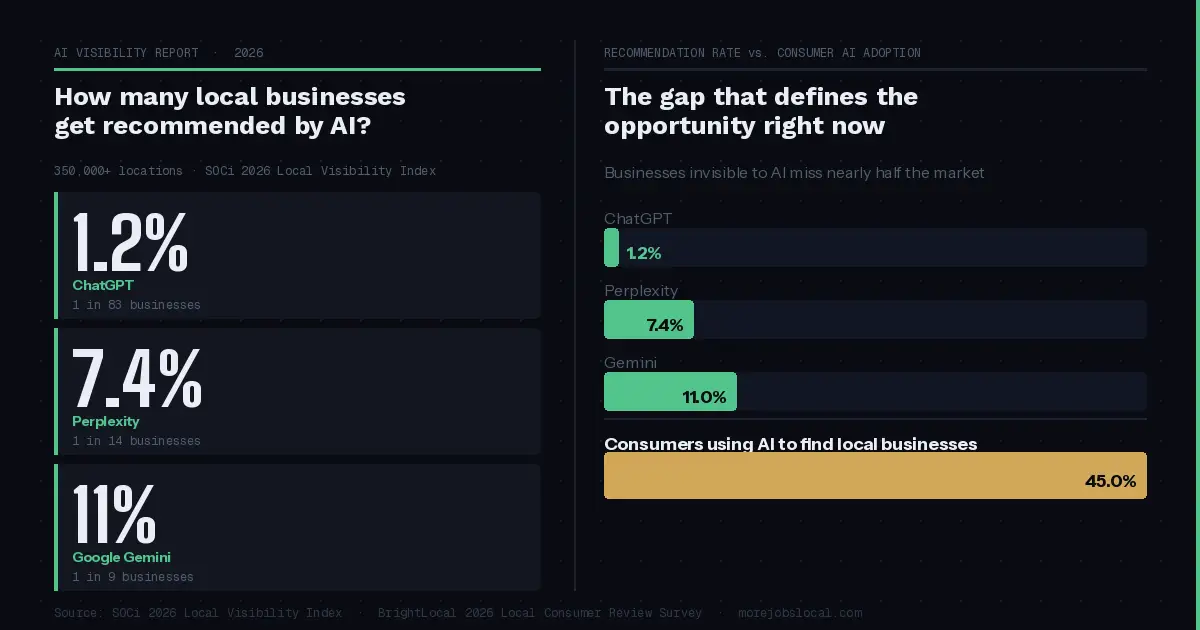
Here's the number that should get your attention: according to SOCi's 2026 Local Visibility Index, which analyzed over 350,000 business locations, ChatGPT recommended just 1.2% of those locations. The index covers multi-location brands rather than independent businesses. Gemini recommends 11%. Perplexity recommends 7.4%. Meanwhile, 45% of consumers now use AI tools to find local businesses — up from 6% just one year ago. That is a 650% increase in a single year.
The math is direct: nearly half of your potential customers are asking AI for recommendations, and AI is ignoring 98.8% of businesses when answering.
The businesses that do appear are not necessarily the oldest, the biggest, or the most established. They are the ones whose websites and profiles are set up the way AI needs them to be. That gap can be closed — and closed faster than most business owners expect.
What It Actually Takes to Show Up
The fix is not complicated, but it has to be done correctly. AI tools build their recommendations from five signals: consistent business information across the web, strong and recent Google reviews, service pages that directly answer customer questions, schema markup (code that tells AI exactly what you do and where), and FAQ content written the way customers actually ask questions.
Most businesses are missing at least three of these. The ones that have all five get recommended. The ones that don't, don't — regardless of how good their actual service is.
The fastest way to understand what this looks like in practice is to see a real example.
Field Test: How SetupTeam Went from Invisible to Consistently Recommended
Disclosure: SetupTeam is operated by the author of this article. All AI visibility results described were observed on a live operating business prior to MoreJobsLocal being offered as a service to clients.
SetupTeam is the live field test for every recommendation on this page. The changes described below were implemented on a real operating business and observed through live AI prompts — not simulated.
At the start of 2025, SetupTeam had no meaningful AI visibility. A customer asking ChatGPT or Perplexity for a Sonos installer in Toronto would not see SetupTeam mentioned. Good reviews, real expertise, a legitimate operating business — none of it mattered because the website was not structured the way AI tools need to read it.
Over the course of the year, a structured AI and local SEO optimization was implemented:
Consistent review collection after every job, with guidance to mention the service and location
Results: By mid-2025, SetupTeam was appearing in AI-generated answers for Sonos installation in Toronto, TV wall mounting in Richmond Hill, home theatre installation across the GTA, and Wi-Fi network installation in Newmarket and Oakville. Results vary by query, location, and device — but visibility is consistent across all AI platforms tested.
Want results like these for your business? We run the same process on your site — free for the first six months.
★★★★★ "Called Alex same day. He came to Markham, fixed my Sonos system that someone else had installed incorrectly, and coached us on how to use the controls. Fixed it in no time. Totally impressed."
— Garry, Markham · Sonos Repair (Facebook)
★★★★★ "Alex is your man for home networks. Fantastic experience from start to finish — everything running exactly as expected. If you need your home network done right, look no further."
— Johan Reinders, Home Network · GTA (Google)
★★★★★ "Been using SetupTeam for years and recommended them to several others — all equally pleased. Ilia and Alex are a pleasure to deal with. Prices are very reasonable and service is always top notch."
— BKK, Long-term client · GTA (Google)
As of publication, SetupTeam's combined review record across Google, HomeStars, Facebook, Houzz, and Yelp stood at 617 reviews with a 5.0 average — the aggregate shown on its review page. Counts change over time; the linked page is the live figure.
See it for yourself. Try these live searches right now:
Source: SOCi 2026 Local Visibility Index — 350,000+ business locations analyzed
The Five Signals That Determine AI Local SEO Visibility
Now that you have seen what the outcome looks like, here is exactly how it is built.
1. Information Consistency Across Every Platform
If your business name, address, and phone number appear differently on your website, Google Business Profile, Yelp, and Facebook, AI tools get confused. They may not aggregate your reviews correctly. They may treat listings as separate businesses. They may simply exclude you.
Audit every place your business appears online. Make sure the name, address, and phone number match exactly — same formatting, same spelling, same suite number.
2. Recent, Detailed Google Reviews
The recency and quality of reviews matters more than the total count. A business with 8 reviews from the last two months will often outperform a competitor with 200 reviews from 2019. Locations recommended by ChatGPT averaged 4.3 stars; businesses with low ratings and low response rates were effectively invisible regardless of how many years they had been operating.
AI also looks for reviews that mention the service type and location. "They mounted my TV in my Thornhill condo and ran all the cables behind the wall" does more for your AI visibility than "Great service, 5 stars." Specific language is what AI extracts and uses.
Build a simple habit: after every job, ask your customer for a Google review and suggest they mention what you did and where.
3. Service Pages That Answer Real Questions
Think of AI content in terms of questions, not keywords. Instead of "we offer professional TV installation services," a page should say: "We are a top-rated TV wall mounting company offering professional installation, cable management, and same-day service across Toronto and the GTA. A standard TV mount with cable management typically takes 90 minutes and costs between $150 and $350 depending on wall type and TV size."
That second version is extractable. AI can pull it, trust it, and quote it as an answer. Every service should have its own dedicated page — not a paragraph buried in a generic list — covering what it costs, how long it takes, what areas are served, and what brands are used.
4. Schema Markup — The Code AI Reads Behind Your Website
Schema markup is code added to your website that tells AI tools exactly what your business is, what it does, where it operates, and what customers say about it. Humans never see it. AI reads it constantly.
For a local service business: LocalBusiness schema (service area, hours, contact details), Service schema for each offering, FAQPage schema for your Q&As, and Article schema for blog content. Structured data contributes approximately 10% to Perplexity's ranking factors and improves citation rates across all major AI platforms.
Most small business websites have none of this. Implementing it correctly is one of the highest-leverage changes you can make. Schema also pairs with a newer class of AI visibility files like llms.txt that describe your site to AI systems directly.
5. FAQ Content That Mirrors How Customers Ask Questions
FAQ pages are one of the most direct signals AI uses when deciding whether your business is the right answer for a conversational query. When someone asks "how much does it cost to mount a TV in Toronto" and an AI reads your FAQ that says "Professional TV wall mounting in Toronto typically costs between $150 and $350 depending on TV size, wall type, and whether cable management is included" — that match is how recommendations happen.
Every major question your customers ask before hiring you should have a direct, honest answer on your website. Most businesses have zero of these. That gap is easy to close, and very few competitors have closed it yet.
How This Was Measured
This section documents the methodology used to track SetupTeam's AI visibility — so the results can be evaluated as evidence, not marketing copy.
Platform
Access method
Query types tested
What counts as a recommendation
Google AI Overviews
Live Google search
Service + city, recommendation-style, problem-first
Business name appears in AI-generated answer
ChatGPT
GPT-4o with web browsing enabled
Same query set as Google
Named recommendation, cited source, or mentioned provider
Perplexity AI
Pro tier, real-time web access
Same query set as Google
Named recommendation, cited source, or mentioned provider
Cities tested: Toronto, Richmond Hill, Vaughan, Oakville, Markham, Newmarket, Aurora.
Testing period: Manual prompts run at regular intervals throughout 2025. Before/after snapshots taken at project start and at the 6-month mark.
Limitations: AI results vary by user location, device, and search history. Results documented here reflect testing from the GTA. Businesses in other markets will see different competitive landscapes.
The Timing Problem: Why This Matters More Right Now
In 2024, a consumer searching for a contractor or service provider would type a query into Google and get a list of ranked results. In 2026, the same consumer is increasingly likely to ask ChatGPT, Perplexity, Google's AI Mode, or another AI tool — and receive two or three direct recommendations instead of ten links. For small businesses that don't appear in those recommendations, the referral simply doesn't happen. No notification. No dashboard alert. No visible ranking drop.
What Doesn't Work — And Why Business Owners Waste Money on It
Running Google Ads does not help AI recommendations. Paid search and AI visibility operate on entirely separate systems. Ad spend has no effect on whether ChatGPT or Perplexity recommends your business.
Having a website is not enough. A website that lists your services but does not answer questions, has no schema markup, and has not been updated in two years is effectively invisible to AI. Having a presence is different from being AI-readable.
Old reviews don't carry much weight. A 4.8-star average built on reviews from 2018 carries far less weight than a 4.3-star average built on consistent monthly reviews from the last six months. AI systems weight recency because recent reviews confirm the business is active.
Weeks 1–4: Service pages and schema markup implemented. Google Business Profile audited and updated. Review collection process started.
Weeks 4–8: AI tools begin indexing updated content. Branded queries start surfacing the business in AI results.
Months 3–6: Consistent review volume and content updates build AI confidence signals. The business starts appearing for competitive non-branded queries.
Month 6 onward: AI visibility compounds. Each new piece of content, each new review, and each new mention on the web reinforces the AI's confidence in recommending the business.
What MoreJobsLocal Does — And Why the Model Is Different
Most marketing agencies sell monthly retainers with vague deliverables and dashboards full of metrics that do not translate to booked jobs.
MoreJobsLocal is built around one outcome: getting your business recommended by AI when local customers are looking for exactly what you do. The work is the same process used on SetupTeam — founder-led, field-tested, results documented.
The first six months are free. If visibility grows, you decide whether to subscribe, buy the site outright, or walk away. All three options are priced in writing before work starts.
What is AI visibility for local businesses, and why does it matter in 2026?
AI visibility means your business appears when someone asks ChatGPT, Gemini, Perplexity, Siri, or Google's AI Overviews for a recommendation in your service area. It matters because 45% of consumers now use AI tools to find local services — up from 6% one year ago. Businesses that don't appear are invisible to nearly half the market.
How is AI visibility different from regular local SEO?
Traditional local SEO focuses on ranking in Google's organic results and map pack. AI visibility is about giving AI tools enough confidence to recommend your business in a conversational answer. You can rank well on Google and still be completely invisible to ChatGPT or Perplexity — the signals are different and both are required.
Does running Google Ads help me appear in AI recommendations?
No. Paid advertising has no effect on AI recommendations. ChatGPT, Perplexity, and Gemini do not factor ad spend into their answers. AI recommendations are built entirely on organic signals: reviews, website content, schema markup, and consistent business data. Businesses that run ads without fixing these foundations remain invisible to AI.
How important is schema markup for local AI visibility?
Schema markup is one of the highest-leverage changes a local business can make for AI visibility. It is code that tells AI tools exactly what your business is, where it operates, and what it offers. Research indicates structured data contributes approximately 10% to Perplexity's ranking factors. Most small businesses have none — installing it creates an immediate competitive advantage.
How many Google reviews do I need to start appearing in AI recommendations?
There is no exact minimum. AI tools consistently favor businesses with above-average ratings and recent activity. Businesses recommended by ChatGPT averaged 4.3 stars in SOCi's 2026 research. A business with 20 recent, detailed reviews will typically outperform a competitor with 150 older reviews. Recency matters more than volume.
Can a small local business compete with larger companies in AI search?
Yes — and local businesses often have a structural advantage. AI tools weight geographic relevance heavily. A well-optimized independent plumber can outperform a national chain for city-specific queries because AI prioritizes confident, specific local recommendations. The key is specificity: service pages, reviews, and schema tied clearly to a specific city and service type.
What types of local businesses benefit most from AI visibility optimization?
Any local service business where customers search before booking benefits significantly — trades, home services, health and wellness, legal, financial, and specialty services. Businesses with higher ticket sizes and lower booking frequency — where one AI recommendation can mean a $500–$5,000 job — typically see the most direct return on investment.
What happens to my AI visibility if I ignore it and focus only on Google rankings?
Your Google presence still matters. But the share of customers who begin their search in an AI tool rather than Google grew from 6% to 45% in one year. Businesses optimizing only for Google are leaving an increasing share of high-intent customers to competitors who appear in AI answers. Both strategies must run in parallel.
Do I need to be listed on Yelp, Bing, and Apple Maps, or is Google enough?
Google Business Profile is the most important single platform. However, AI tools draw from multiple sources to verify your business identity. Business information was only 68% accurate on ChatGPT and Perplexity — largely due to directory inconsistencies. Maintaining accurate, consistent listings on Yelp, Apple Maps, and Bing significantly reduces the chance AI tools exclude your business.
How long does it take for AI to start recommending a local business after optimization?
Most businesses begin seeing AI citations within 4 to 8 weeks of implementing the right changes. Initial visibility typically appears first for branded queries and lower-competition service-city combinations. Competitive non-branded queries — "best plumber in Toronto" rather than your business name — generally take 3 to 6 months of consistent content and review activity.
What is the difference between Google AI Overviews and being recommended by ChatGPT?
Google AI Overviews appear at the top of Google search results and pull from websites Google has already indexed. ChatGPT draws from its own training data and live web browsing. Optimizing for both requires slightly different approaches, but the foundational work — clear service pages, schema markup, strong reviews, and consistent NAP data — benefits all platforms simultaneously.
Is this something I can do myself, or do I need professional help?
Updating your Google Business Profile and requesting reviews can be done without technical knowledge. Implementing schema markup correctly and restructuring service pages for AI readability typically requires professional help. Incorrect implementation can be as harmful as no implementation — a malformed schema block can actively confuse AI crawlers.
Book Your Free Audit
We'll pull your rankings, speed score, and AI visibility and send your report in about five business days. No pitch unless you ask for one.