Local SEO Audit for Home Service Businesses and small businesses
If your plumbing, HVAC, roofing, or electrical business isn't showing up when someone nearby searches on Google, the problem isn't effort — it's signals. Google needs to trust your business before it shows it. A local SEO audit tells you exactly where that trust is missing and what to fix first.
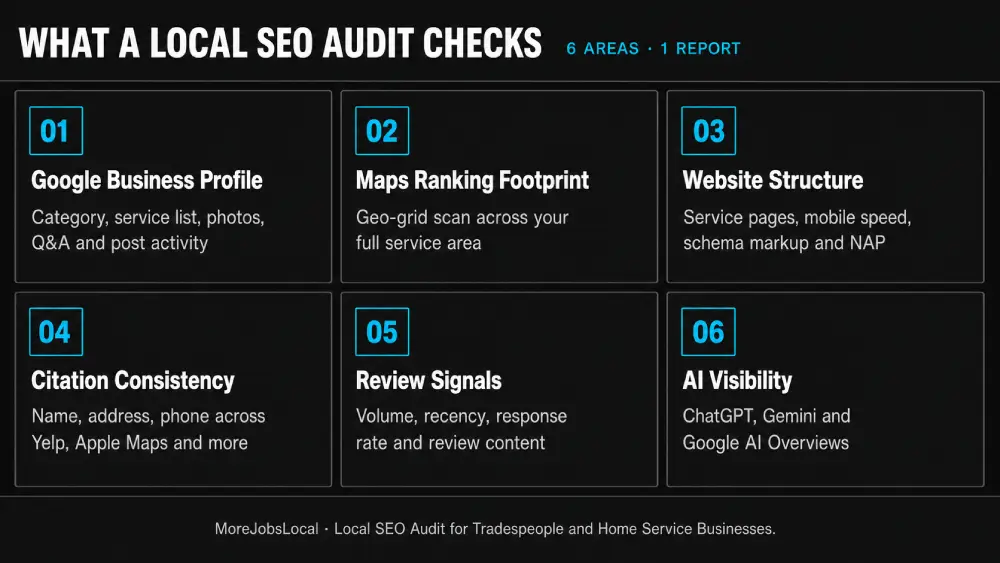
A local SEO audit covers six areas: your Google Business Profile, Maps ranking footprint, website structure, citation consistency, review signals, and AI visibility.
We pull the data, compare your presence against the businesses currently outranking you, and deliver a written report you can act on — whether you work with us or not.
A local SEO audit reviews the factors Google uses to decide which businesses appear in Maps results, the local 3-Pack, and organic search. Most businesses have a mix of things working and things quietly costing them rankings — often without any obvious sign something is wrong.
Here are the six areas every audit covers.
1. Your Google Business Profile — SEO for Google My Business
Your Google Business Profile (GBP) is the most important signal for Maps ranking. The audit checks whether your primary category matches how people actually search for you, whether your service list is complete, whether your photos are recent, and whether your Q&A section has been maintained. A wrong or missing primary category alone is enough to drop you out of the 3-Pack for your most valuable searches.
2. Your Local Ranking on Google Maps
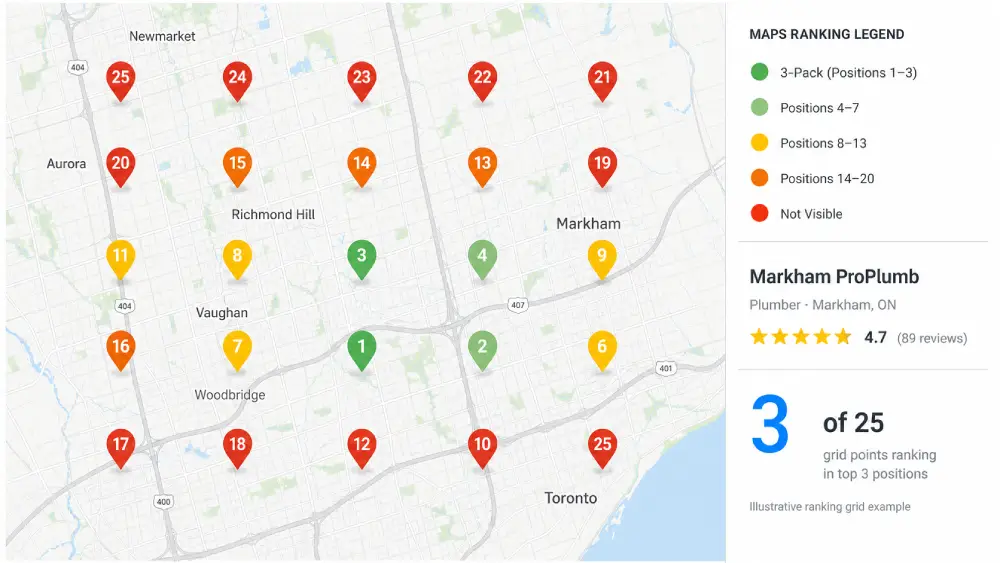
Your Maps ranking isn't a single position — it shifts depending on where the searcher is located. The audit uses a geo-grid scan to map where you currently rank across your full service area, neighbourhood by neighbourhood. If you're an HVAC technician in Vaughan, you need to know whether you're visible in Woodbridge and the surrounding communities — not just near your registered address. The grid shows the gaps clearly.
3. Your Website — Page SEO Audit
Your website reinforces — or undermines — your GBP. The audit checks whether you have service-specific pages, whether those pages load quickly on mobile, whether your business name and phone number match your GBP exactly, and whether structured data (schema markup) is present and correctly implemented. A generic homepage with no service content makes it harder for Google to confirm your profile is trustworthy.
4. Citations and Local Search Engine Optimization Signals
Citations are mentions of your business name, address, and phone number across directories — Yelp, Yellow Pages, Apple Maps, Bing Places, and industry-specific directories. When these details are inconsistent — a different phone number here, an old address there — Google has reason to doubt your business information. The audit identifies your main citation sources and flags the conflicts that need fixing.
5. Reviews and Google Business SEO
Review volume, recency, and the text content of your reviews all influence your Maps ranking. The audit looks at how many reviews you have, how recently they arrived, whether you're responding to them, and how your profile compares to the top competitors in your category. Whether reviewers mention your services and city also matters — Google reads that as a local relevance signal.
6. AI Visibility — Local SEO and AI Search
More people are finding local businesses through AI platforms — ChatGPT, Google AI Overviews, Gemini, and Perplexity. These systems pull from your website content, your schema markup, and your citation footprint to decide whether your business is worth recommending. The audit checks whether your presence has the structured signals needed to appear in AI-assisted answers, not just traditional search results.
Why Isn't My Business Showing Up in Local SEO Google Maps Results?
There's usually more than one reason, which is why guessing rarely fixes it. The three most common causes are a category mismatch, a proximity gap, and a website disconnect.
Illustration of the geo-grid report format — not a scan of a specific business.
Category mismatch. Google uses your primary GBP category to match your business to searches. If you're listed as a "General Contractor" but most of your revenue comes from drain cleaning, you won't rank well for drain-related searches — even if you're the most experienced contractor in the area.
Proximity gap. Your Maps ranking shifts based on where the person searching is standing. If your business pin sits outside the neighbourhood where your target searches originate, you're at a structural disadvantage. This is especially common for service area businesses — trades and home service operations without a storefront in the area they want to rank.
Website disconnect. If your GBP says you're a roofing company in Newmarket but your website has no roofing-specific pages and no mention of Newmarket, Google has a harder time confirming your profile is legitimate. The website acts as a trust reference for the GBP. Without that confirmation, the profile carries less weight in local results.
The audit identifies which of these is at play — and what the right fix looks like — rather than asking you to guess and test your way to an answer.
What's Included in Our Local SEO Package?
The local SEO package starts with the audit. What you receive is a complete picture of your local visibility — where you stand, where the gaps are, and what to address first.
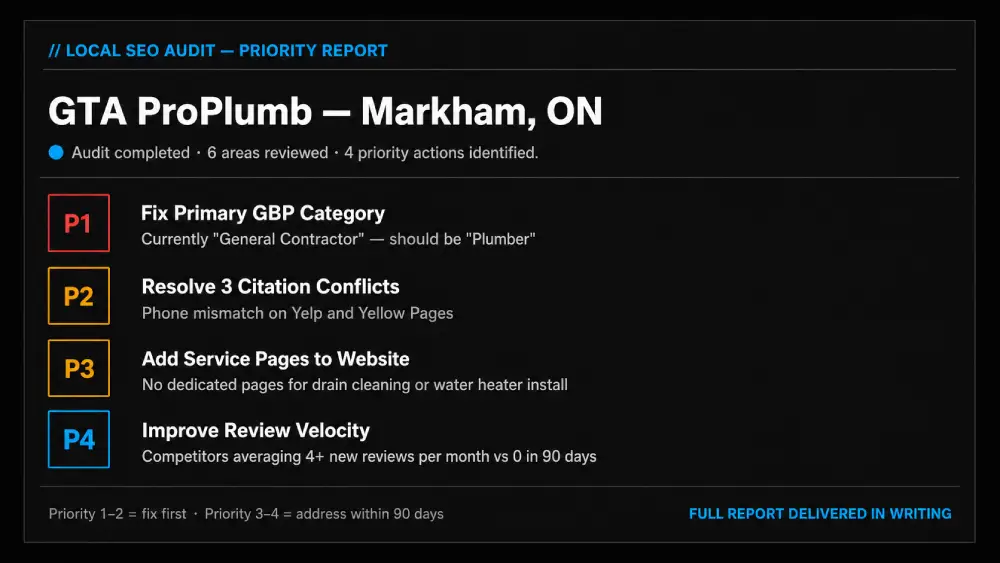
Written audit report — a clear document that tells a plumber, roofer, or HVAC technician what was checked, what was found, and what the priorities are. Not a 50-page PDF you'll never open.
GBP comparison — your profile scored against the top competitors in your category and location, with specific category, photo, review, and service gaps identified.
Geo-grid ranking map — a visual of where you currently rank across your service area so you can see exactly which neighbourhoods you're reaching and which you're not.
Website review — page structure, mobile load speed, NAP consistency, and schema markup presence checked against local SEO standards.
Citation snapshot — your key directory listings reviewed for accuracy and conflicts across major platforms.
AI visibility check — whether your presence has the structured signals needed to surface in ChatGPT, Gemini, and Google AI Overviews. Learn more about AI visibility for local businesses.
Priority action list — ranked by expected impact so you fix what matters most first, not what's easiest to tick off.
If you want help acting on the findings, that conversation happens after the audit — not before. No assumptions, no automatic upsell.
How Do Local SEO Specialists Find What's Holding Your Business Back?
The process starts from data, not assumptions. Here's what the work actually looks like.
We pull your current GBP data and compare your profile against the top three to five businesses ranking for your main service keywords in your area. We look at their categories, review velocity, photo activity, and service lists — not to copy them, but to understand what Google is already rewarding in your specific market and category.
We run a geo-grid scan across your service area. This shows your Maps ranking position at dozens of points across the area you want to reach. Most businesses discover their visibility drops significantly just a few kilometres from their registered address — sometimes to page two or beyond.
We review your website for the local signals that support or undermine your GBP. Service page depth, mobile performance, structured data, and NAP alignment are the main checkpoints. A website that says the right things in the right structure reinforces your GBP and improves Google's confidence in showing you.
We check your key citation sources for name, address, and phone inconsistencies. Even small discrepancies across Yelp, Yellow Pages, and Apple Maps introduce signals that work against your local authority.
The output is a written report with a clear priority order. Local SEO consulting isn't about handing you a 40-point checklist — it's about identifying the three to five changes that will actually move your ranking this quarter. For businesses without a fixed storefront, see how Google Maps ranking for service area businesses works differently than standard local SEO.
What Does a Website Audit Online Actually Reveal About Your Local Visibility?
Most tradespeople don't realize how directly their website affects their Maps ranking. Google uses the site linked to your GBP as a reference point to confirm what your profile claims about your business.
A website audit online checks the elements that are most often overlooked:
Service page depth. Does your site have individual pages for your main services, or is everything on the homepage? A plumber's site benefits from separate pages for drain cleaning, water heater installation, and emergency repair — not for aesthetic reasons, but because Google reads those pages as confirmation of what you actually do.
Mobile page speed. A slow-loading site on a phone is a ranking disadvantage. Most local searches happen on mobile. If your pages take more than three seconds to load on a standard connection, that's a problem worth fixing before anything else.
Schema markup. Structured data tells Google what your business is, where it operates, what it offers, and how to contact it. Without schema, Google infers those details from your text alone — which is slower and less reliable. Schema is one of the clearest local trust signals a website can send.
NAP consistency. Your business name, address, and phone number on your site must match your GBP exactly. Differences as minor as "Street" versus "St." can introduce inconsistency that weakens your local authority over time.
Fixing website-level issues tends to have downstream effects — improvements in both your Maps ranking and your organic search visibility. The organic SEO overview covers how website structure supports your broader search presence beyond Maps.
How Long Does Local SEO Optimization Take to Show Results?
It depends on your starting point and the competition in your category. Here's an honest breakdown.
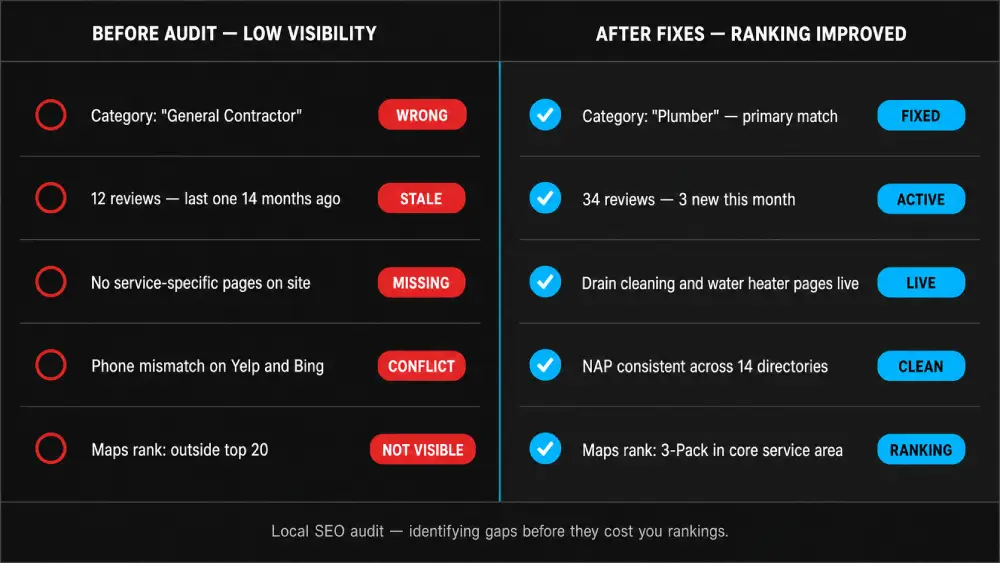
Businesses with significant gaps — wrong GBP category, incomplete profile, no service pages, inconsistent citations — often see early movement within 30 to 60 days of addressing the main issues. Not a full ranking shift, but measurable improvement in how often the profile appears and how far the geo-grid extends.
Businesses in more competitive categories — plumbing, HVAC, roofing in Toronto, Vaughan, or Mississauga — typically take six months to build consistent 3-Pack visibility, and twelve months for the full picture to stabilize. More competitors, higher bar to reach the top, longer timeline to hold it.
The audit gives you a head start. Instead of spending the first three months fixing the wrong things, you know from day one which issues matter most. That's the practical value of beginning with a clear baseline rather than jumping into optimization work blind.
No one can promise a specific ranking or a specific number of calls. Google's algorithm changes, and so does what your competitors are doing. What the audit gives you is a documented starting point and a clear priority order — so the work that follows is pointed in the right direction from the beginning. If you want to understand how AI search is changing what local visibility means in 2026, the guide to AI visibility covers the fundamentals.
Frequently Asked Questions About Local SEO Services
A local SEO audit is a structured review of your business's online presence across Google Search, Google Maps, your website, and AI search platforms. It identifies specific gaps — wrong categories, missing schema, inconsistent contact details — and tells you which ones are most likely holding your rankings back. Think of it as a diagnostic, not a report card.
The audit covers six areas: your Google Business Profile, your Maps ranking footprint across your service area, your website structure and page relevance, your citation consistency across directories, your review volume and recency, and your AI visibility on platforms like ChatGPT, Gemini, and Perplexity.
A regular SEO audit focuses mainly on your website — title tags, page speed, backlinks. A local SEO audit goes further: it reviews your Google Business Profile, your Maps ranking across your service area, your directory citations, and your review signals. For tradespeople and service area businesses, those local-specific factors matter most.
The clearest signals are calls and form fills that originate from Google Search and Maps. Inside Google Business Profile Insights, you can see how many people called, requested directions, or visited your website from your profile. If those numbers are flat while you're running ads to stay visible, your organic local visibility needs attention.
There are usually a few overlapping causes: a GBP category that doesn't match what people search for, a business location that sits outside the area where searches originate, or a website that doesn't clearly confirm your services and service area. An audit identifies which of these is the actual cause rather than asking you to guess.
NAP stands for Name, Address, and Phone. When your business details appear differently across directories — a different number on Yelp, an old address on a listing, a slightly different business name elsewhere — Google has less confidence in your business. That uncertainty reduces your local ranking. An audit flags these conflicts so they can be corrected.
Review volume, recency, and the content of reviews all influence your Maps ranking. A business with 12 reviews from two years ago is at a disadvantage against a competitor adding four or five reviews each month. Whether you respond to reviews, and whether reviewers mention your services and city, also send signals Google reads as local relevance indicators.
Yes, directly. Google uses the website linked to your GBP to confirm your services, location, and relevance. If your GBP says you're a plumber in Vaughan but your website has no service-specific pages and no mention of Vaughan, that mismatch reduces trust. A well-structured website reinforces your GBP and supports better Maps placement.
A GBP audit reviews your Google Business Profile against the factors Google weighs for local ranking: primary and secondary categories, business description, service areas, service list, photo activity, post recency, Q&A section, and review response rate. It also compares your profile against the top-ranking competitors in your category to show specific gaps.
Most businesses see early movement in 60 to 90 days for lower-competition searches, and more consistent gains between 90 and 180 days. More competitive categories and dense urban markets take longer. There are no guaranteed timelines — Google's algorithm is outside anyone's control. The audit helps you fix the highest-impact issues first so you're not waiting longer than necessary.
Yes — having a website and having a well-optimized local presence are two different things. Many businesses have functional websites that don't reinforce their GBP, lack local service pages, load slowly on mobile, or have no structured data. The audit tells you which of these gaps exist and which are most likely affecting your Maps and search visibility.
Increasingly, yes — but most businesses are invisible to AI search because their website and GBP lack the structured signals those systems extract. AI platforms draw from schema markup, page content, citations, and review presence to determine whether a business is worth recommending. The audit checks these signals and flags where AI visibility is weak.
You receive a written report identifying what's working, what's broken, and what should be addressed first. If you want help implementing the fixes, we can talk through the right next step — whether that's a Google Maps ranking service, an organic SEO engagement, or a website build. Nothing is assumed or automatic. You decide what to act on.
Once a year is a reasonable baseline for a stable business. More frequently if you've recently changed your address, updated your phone number, launched a new service, or noticed a drop in calls or Maps visibility. Competitive categories — plumbing, HVAC, roofing in major cities — benefit from a review every six months to stay ahead of changes in competitor activity and Google's ranking updates.
Request a Free Local SEO Audit for Your Business
We pull your Google Maps ranking data, review your GBP against your top competitors, and check your website and citations — then deliver a written report with a clear priority list. No pitch. No pressure. Just the data.
Serving tradespeople and home service businesses across the GTA and York Region — Toronto, Vaughan, Markham, Richmond Hill, Newmarket, and surrounding Ontario communities. If you're in York Region, see the local SEO audit Richmond Hill page for area-specific details.
The audit is free. No retainer, no contract, no follow-up unless you ask for one. You get the report either way.